Immigrants can’t vote today. Your vote speaks for them. | Will Bunch Newsletter
Plus, can anyone stop the insanity of the Iran War?

One of the joys, or perils, of a weekly Tuesday newsletter is coming out every year on Election Day, right when the world is on hold for those 13 or so hours the polls are open. If you live, as I do, in a corner of Pennsylvania without a hotly contested congressional race, and with Gov. Josh Shapiro up by double digits, the day might seem less consequential. That’s wrong. Not only is control of the state legislature on the line, but we’re fighting for a bigger principle: the right to vote again in a free and fair election in two years. Vote as if your life depends upon it, because in a sense, it does.
If someone forwarded you this email, sign up for free here.
Those with the most riding on Election Day can’t vote: the undocumented
In Maryland, a man named Julian Curo Churata arrived more than a decade ago from Peru to work as a carpenter and build a new life with his wife, Veronica Ramirez, their two children from previous marriages, and eventually their own daughter, now age 6.
In June, as Donald Trump’s campaign of mass deportation was surging across America, agents from U.S. Immigration and Customs Enforcement (ICE) arrested Curo Churata in a targeted operation, and the undocumented immigrant was flown to detention in Louisiana. He managed to call his daughter every day — pretending he was out of town on a job — until Sept. 29, when ICE said he suffered cardiac arrest, was rushed to a nearby hospital, and pronounced dead. He was just 47.
Ramirez went public with her grief, her unanswered questions about her husband’s death, and the lack of information she was receiving from ICE, in a story on the front page of the Washington Post.
“He wasn’t a criminal,” Ramirez said at the time. “All he wanted to do in this country was work. He paid his taxes, he wanted a better future for his children and for me — for his family. He didn’t deserve this at all. I want justice.”
What Ramirez got instead from ICE was a notice to appear for an immigration court hearing that could lead to her deportation to El Salvador — dated just three days after the newspaper article. Now she fears for the future of her already traumatized daughter, who may lose a second parent. “She’s afraid — afraid of being alone,” Ramirez said.
This case of seeming retaliation by an uncaring and increasingly tyrannical U.S. government where the ultimate victim is a defenseless 6-year-old girl is the kind of article that makes your blood boil. But it’s also just one of a series of stories of heartlessness and violent thuggery toward the undocumented on our soil that have polluted my social media feed in recent days.
I saw a video of an ICE agent pointing a gun in the face of an innocent bystander in North Hollywood, Calif. during the arrest of an immigrant, read about the Afghani refugees that ICE plans to fly back to their native country even after their relatives risked everything to aid U.S. troops, and noted the Cuban-American lawyer who voted for Trump in 2024, tried and failed to stop his cousin’s deportation during the ensuing ICE crackdown, and then cried that, “This isn’t what I voted for.”
No, this is exactly what you voted for. I was inside Milwaukee’s Fiserv Forum on the night of July 16, 2024 — watching in horror as white Trump delegates in their red MAGA garb or Texas cowboy hats waved placards that read, “MASS DEPORTATION NOW.” The most despicable campaign promise in American history proved to be the only one Trump kept.
And you still don’t think that elections have consequences?
There are millions of people — who live on our blocks, and pray in our houses of worship, and work the backbreaking jobs in our communities that no one else seems willing to do — who face the greatest consequences from the results of Tuesday’s midterm election. People like Veronica Ramirez and her 6-year-old girl.
Our neighbors with the most to gain or lose from the election results, for whom Tuesday’s election is about a lot more than paying a few cents less per gallon at the gas pump, are also people who cannot vote.
They desperately need you to cast a vote for them.
Hubert Humphrey, the former Democratic vice president known for his outspoken defenses of civil rights in the postwar era, said most famously that “the moral test of government is how that government treats those who are in the dawn of life, and those who are in the shadows of life...”
In today’s United States, no one is forced to retreat into those shadows more deeply than the 14-million-or-so undocumented immigrants and the American dreams of their children, many of whom are U.S. citizens who might have to watch masked government goons rip their parents away.
Unfortunately, it’s a nightmare that won’t end on Wednesday morning no matter who wins, since Trump and his xenophobic henchmen like Stephen Miller will still be in the White House and — barring the unexpected — will be there until Jan. 20, 2029.
But your vote will still make a huge difference. One party will hold public hearings, subpoena top officials, expose evil, and refuse to provide any new dollars to co-opt our local police to arrest our neighbors, hire more masked thugs, or open the squalid equivalent of concentration camps. The other party will continue, and look to expand, a mass-deportation crusade that has become a dark moral stain on our nation.
It’s fine to vote your pocketbook, but Tuesday’s ballot is about so much more. This is a moral imperative.
I know when I vote Tuesday, I’ll be thinking about Wendy Martínez, a woman I met this summer in Pottsville. With her four kids, Martínez rarely left their cramped apartment with the windows covered in blankets after ICE took away her husband, Carlos Moreno. There are thousands like her — women whose family breadwinner was arrested by ICE in a deliberate strategy to drive their families out of the United States.
Martínez won’t be voting Tuesday, but you can.
I think about the family members like Maryland’s Ramirez or Ly Wang, the stepdaughter of a Philadelphia Amerasian immigrant from Vietnam named Tuan Van Bui. whose loved ones died this year in the ICE-detention gulag archipelago, with little or no explanation
Ramirez won’t be voting Tuesday, but you can.
Tuesday’s election caps a year that started with the brutal murders by immigration officers in Minneapolis of two U.S. citizens, Renee Good and Alex Pretti, who objected to what the government is doing in our name.
Good and Pretti won’t be casting ballots on Tuesday, but you can. If you care about justice, you must.
Many are. Tuesday morning, I woke up to see a photo online of the ever-growing memorial to Pretti on the Minneapolis street corner where the protester was gunned down nine months ago. A number of Minnesotans have traveled straight from their early-voting site to the memorial, and attached their “I Voted” stickers.
Immigration, of course, isn’t the only important issue on the ballot. It’s not even the only moral one. You can play a role in ending the erosion of gains for Black and brown Americans in the classroom and the voting booth, turning the tide back toward the LGBTQ community, including our transgender neighbors, and electing more opponents of U.S. militarism from Iran to the Caribbean.
But the fiercest battle for the soul of America is being waged in the streets of our immigrant communities. Sen. Bernie Sanders used to ask his rallygoers, “Are you willing to fight for that person who you don’t even know as much as you’re willing to fight for yourself?”
This Tuesday, the existential question is, are you willing to vote for the immigrant who can’t — even more than you’re willing to vote for yourself?
Yo, do this!
Philadelphia is a city that’s spawned a million stories, and a lot of them have ended up on the big screen. But Rocky will always be the ultimate film about our town, freezing in time the 1970s moment that blue-collar gumption that became Philly’s calling card. So the next best thing would have to be a drama about how Rocky was made. I’m really looking forward to I Play Rocky, the Sylvester Stallone mini-biopic that opens in a few selected theaters Friday before going wide on Nov. 20. Punch out a few slabs of meat while you wait.
After Rocky, the thing that’s come to define civic grit in Philadelphia is our never-ending love affair with the NFL’s Eagles, who’ve fallen from the skies in 2026 in a bloody trail of feathers. But there’s also hope, and not just from LeBron James’ streaking new-look 76ers. The Major League Soccer playoffs are almost here, and the rejuvenated Philadelphia Union are going to be in the thick of things. First comes Saturday’s Decision Day, when Cavan Sullivan and his mates play Toronto at 4 p.m. looking to rise in the playoff seedings. Check it out on Apple TV.
Ask me anything
Question: Will PA be governed by a Dem trifecta at the end of the week? If so, what are the most meaningful changes that will be put into place? — @nufcnuf.bsky.social via Bluesky
Answer: I’ve been pondering this myself. Although I haven’t followed individual state legislative races very closely, my sense is that a “blue wave” at the ballot box could be enough to not only expand the one-vote Democratic majority in the state House, but pick up the three seats needed for the party to also retake the Senate. Then what? I’d watch several issues that are broadly supported across the spectrum of Democrats that have been stymied in the past by GOP lawmakers: commonsense gun laws, LGBTQ rights, and finally an increase in the state’s lowest-in-the-nation minimum wage. For any progressive legislation beyond that, the wild card is Gov. Josh Shapiro. Does he stick to his normal, very centrist political instincts? Or does he look to curry favor with left-wing voters in the 2028 presidential primaries? One issue I’ll watch intensely is whether Pennsylvania can follow the lead of neighboring states and ban local police agreements with ICE under the controversial program known as 287(g).
What you’re saying about...
As I expected, last week’s question about top Democratic priorities for the new Congress drew the most robust response in months. Readers have a massive to-do list for Dems if they do indeed retake control of Congress. Your suggestions include impeaching the worst cabinet members like Pete Hegseth at the Pentagon and Todd Blanche at Justice; end the war in Iran and restore the U.S. foreign aid that was gutted in the early weeks of the Trump regime, repeal 2025’s so-called Big Beautiful Bill while enacting legislation to restore health insurance subsidies and nutrition benefits. The most common concern is rooting out corruption. Margaret Manos wrote that she believes the “first thing to do is to investigate Trump’s criminality and corruption and self-dealing and emoluments violations.” But regular contributor Mary Ann Petro wants to see lawmakers focus on making laws again. “Our country has had a do-nothing Congress for two years so actually getting any type of lawmaking done would be a step in the right direction,” she wrote, echoing the late great Harry Truman.
📮 This week’s question: The end of the midterm election can only mean one thing: The 2028 presidential race is officially underway. During the fall campaign, whose political stock — any individual Democrat or Republican — rose the most? Who plummeted in the rankings? Please email me your answer and put the exact phrase “2028 presidential hopefuls” in the subject line.
Backstory on the other postelection fear: Iran
Donald Trump has struggled to give American voters good news in the run-up to the election, and you might have missed this seeming bombshell — or maybe you could call it the lack of a bombshell — when the president spoke with Fox News’ Sean Hannity on Monday night. It turns out there actually is no war in Iran.
“But this isn’t like a war that’s going on,” Trump insisted of the Middle Eastern conflict that he initiated in late February, and which has proved to be incredibly unpopular with voters. “There’s no war raging. It could happen if they don’t make a deal, but they want to make a deal very badly, and there’s a very good chance we make a deal.”
Literally as Trump was speaking with his longtime friend, the U.S. military was dropping a new round of bombs on Iran’s Qeshm Island, a key strategic outpost in the fight for control of oil traffic through the bitterly contested Strait of Hormuz. Pentagon sources told the Wall Street Journal, which broke the story of the attack by a military that’s stopped giving public briefings on the war, that the new bombing was in response to Iranian attacks on a U.S. drone and potshots at two fighter jets. To any rational person, it sounds like a war is raging.
And now that the U.S. election is winding down, things could get a lot worse on the other side of the planet.
The president has given wildly mixed signals in recent days on whether the war would resume after voting ends — a conversation that has linked killing and politics in ways that should make all of us uncomfortable. But news reports have suggested that — urged on by Israeli Prime Minister Benjamin Netanyahu, who just like Trump is clinging to political power — the Pentagon has a plan for a short but intense post-election attack on Iran
Last week, Connecticut Democratic Sen. Chris Murphy, a vocal critic of Trump’s foreign policy, revealed at a forum that as a member of the Senate Foreign Relations Committee he’s received a Pentagon briefing on the war plan and while he’s sworn to secrecy about the operational details, the overall idea is, in his words, “insane.” Murphy suffered a stroke a couple of days later (aides said the 53-year-old senator is expected to fully recover, thankfully) — a likely coincidence that some will view as a metaphor for the stress of trying to restrain a president’s madness.
Analysts say an attack could target Iran’s infrastructure such as its electrical grid — arguably, a war crime — and could include the United States dropping the so-called “mother of all bombs” on an alleged Iranian nuclear site. And for what? The Trump regime has yet to adequately explain a war that’s killed at least several thousand Iranians and 22 U.S. troops. A Democratic Congress could take concrete steps to end this madness — both by passing the War Powers Act and using its authority over the purse to cut off funding.
It’s one more reason why the stakes of a midterm election have never been higher.
What I wrote on this date in 2020
One thing about Election Day is that it’s always the anniversary of some other important Election Day. Six years ago, Americans went to the polls on Nov. 3, 2020, still wallowing in the COVID-19 pandemic and nearly evenly divided about whether the recently impeached Donald Trump should remain in office. I struggled to write a column that night as it was clear the surge of mail-in ballots meant we would not know the winner for days. “Midmorning, I hopped in my car and headed to St. Maron Maronite Catholic Church in the heart of South Philadelphia, after I’d seen a photo of shivering masses of voters lined up for two blocks,” I wrote. “The church is just a stone’s throw from South Street, where the CVS and Whole Foods were covered in plywood, the stress wall of a national nervous breakdown.” Read the rest: “Democracy thrived in daylight, but a long night for the American soul is just beginning.”
Recommended Inquirer reading
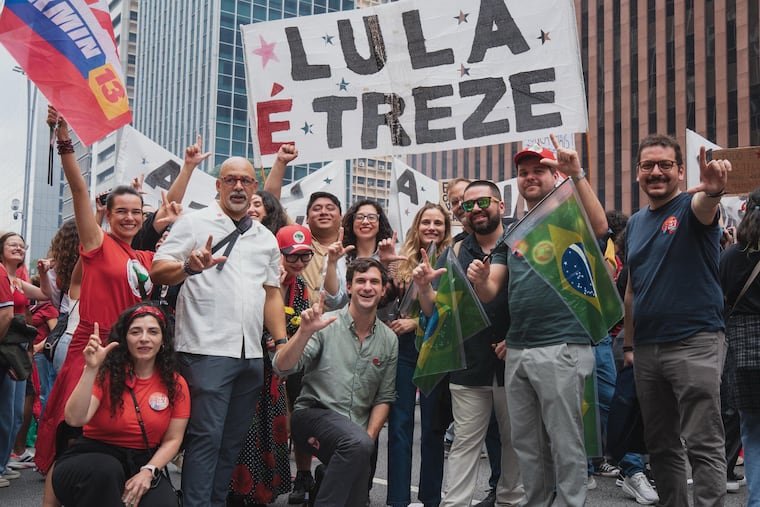
I spent the week before the election with one eye on the potential shenanigans of a White House that doesn’t believe in free and fair elections, and the other on more hopeful future. In that latter category, I interviewed state Rep. Chris Rabb, the all-but-certain next Congress member from the Philly-based 3rd Congressional District, about why he spent some critical days before the U.S. election in Brazil, where he watched and saluted a relection victory for that country’s leftist president, Luiz Inácio Lula da Silva. Over the weekend, I looked at the Trump regime’s push to intimidate voters and possibly nullify the results in the critical U.S. Senate race in Alaska, where a banal Democratic ploy of recruiting a second Dan Sullivan to enter the race is not nearly as big a threat as government election interference.
One war for the soul of America is coming to a climax on Tuesday, but arguably a bigger battle is just getting started. That would be the rising influence of artificial intelligence in our day-to-lives, as noisy, polluting data centers come for our neighborhoods and robots come for our jobs. For many, it was an ominous sign of things to come when The Inquirer reported that Philadelphia’s top business employer, the media giant Comcast — whose two skyscrapers dominate the city skyline — is laying off 600 of the humans who work in those towers. A key part of Comcast’s cost-cutting strategy involves “deploying AI agents to connect with customers.” Meanwhile on the city’s western border, Lower Merion is the latest suburb racing to impose restrictions on AI data centers that have been proposed throughout the region and across Pennsylvania and South Jersey. No matter who wins the election, AI will remain the dominant issue for U.S. society in the 2020s, and in The Inquirer’s daily news report. Follow it every day by subscribing. You might even save some human jobs: ours!
By submitting your written, visual, and/or audio contributions, you agree to The Inquirer’s Terms of Use, including the grant of rights in Section 10.
About our columnists
In contrast to news reporters, who operate within an independent, nonpartisan framework, columnists are charged with including their perspectives, opinions, and viewpoints when presenting their reporting. Inquirer columnists include Jenice Armstrong, Will Bunch, Luis F. Carrasco, Paul Davies, Daniel Pearson, Trudy Rubin, and Sabrina Vourvoulias.

Sign up for the Will Bunch Newsletter