‘High heels to heaven’: Remembering Dolly Parton’s Philly shows
“Long after you’re dead and people research your career and say ‘Damn, that was good!’ These are the things you want to leave behind,” she told the Inquirer in 2001.
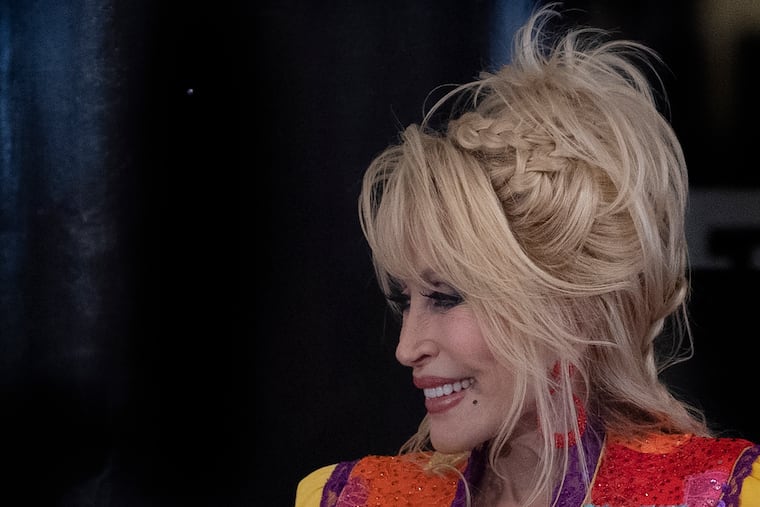
Dolly Parton was a genius-level songwriter, a rhinestone-studded glittering country music queen from Sevier County, Tennessee. Her vaulting ambition manifested itself in down-home masterpieces that transcended the genre, like “Coat of Many Colors,” “Jolene,” and “I Will Always Love You.”
She was an undeniable gracious force of nature and a multimedia star whose “aw-shucks” persona and disarming sense of humor — coupled with bountiful talent — made her that rarest of commodities in a bitterly divided time: a genuinely universally beloved public figure.
Parton, who died at age 80, her nephew Brian Seaver announced in an Instagram post on Tuesday, was always ready with a self-deprecating quip about her flamboyant appearance. “It costs a lot of money to look this cheap,” was one of her favorites, and when asked what she hoped people would think of her 100 years from now, she would say: “Dang, she looks good for her age.”
I met her once, back in 2001 for an interview at the Pierre Hotel in Manhattan. She was promoting Little Sparrow, the second of two excellent bluegrass albums she had released in a little over a year at a time when country radio had all but given up playing her music.
Like Johnny Cash and other icons of her generation, she had attained legendary status, but the industry wasn’t interested in the new music she was making, focusing on younger stars rather than golden greats.
But the last thing Dolly Parton was going to do when Music City turned its back on her was pout or complain.
“We’re older than God!” Parton, who was then 55, told me.
“It ain’t like we ain’t had our day,” she said, referring to herself as well as fellow travelers like Cash and Merle Haggard. “It wasn’t like I didn’t have a great career.”
“But we can’t last forever. And I always try to think ahead,” she said, adding that “ever since I got started in show business, I’ve always tried to pay attention to the business of the show.
“I believe in progress. Change is going to happen … You can’t just stay the same way … I can’t just not sing because I’m not getting played on the radio,” she told me. “I can’t not write just because there’s no real place for me in Nashville.”
Parton, who was the fourth of 12 children, wrote her first song when she was 7. “Little Tiny Tassel Top” was an ode to a corncob doll.
When it came up in conversation, she couldn’t resist singing it.
“I love you an awful lot, my little tiny tassel top,” she sang in a little girl’s crystalline voice. “You’re the only thing I’ve got. Hope you never go away, ’cause I want you to stay.”
At the time, Parton said she planned on continuing to record music that brought her back to her hardscrabble roots because she knew it would resonate with audiences.
“I’ll never do anything that’s as real, that I enjoy singing as much, and that I can sing as well as these songs” so close to her heart, she said.
“These are the kind of statements you want to make. You know, long after you’re dead and people research your career and say ‘Damn, that was good!’ These are the things you want to leave behind.”
I saw Parton sing for larger audiences than just me four more times over the next 15 years.
In 2004, she played the Spectrum in South Philly. At that show, she played a banjo and fiddle while gender-flipping John Denver’s “Thank God I’m a Country Boy.” She accompanied herself on piano on “The Grass Is Blue” and played auto-harp on “Coat of Many Colors.”
And of course, she made jokes, kidding about the size of her chest while referring to a Super Bowl halftime show wardrobe malfunction: “If I was to pull a Janet Jackson tonight, I’d take out everybody in the first three rows.”
Before a show at the Mann Center in 2005, Parton spoke to The Inquirer about her album Those Were the Days, on which she covered folk and pop songs like “Imagine,” “Blowin’ in the Wind,” and “Turn, Turn Turn.”
“I’m one of those people that love all kinds of music,” she said. “I was always listening to all styles of music, and still do.” She went on: “Those songs give you a kind of hope … I am getting that sappy in my old age, to kind of wish things could be better.”
In 2008, Parton performed at the Borgata in Atlantic City in support of her album Backwoods Barbie. In addition to the aforementioned instruments, she also played penny whistle and dulcimer.
She kidded about Whitney Houston’s success with Houston’s smash hit cover of “I Will Always Love You”: “She made me lots of money,” she said. “I will always love her.”
In Atlantic City, Parton reaffirmed the theme that there was always more to her than meets the eye: “I’m just a backwoods Barbie, in push-up bra and heels,” she sang. “I might look artificial, but where it counts I’m real.”
That night, she also talked about working hard on writing new songs for the musical 9 to 5, which opened on Broadway the next year. She predicted that her work ethic was going to compel her to keep clocking in until the end of her days.
“I’ll fall dead on in the middle of a song in front of y’all,” she said cheerfully, “high heels to heaven.”
Parton’s last Philadelphia concert was at the Mann Center in Fairmount Park in 2016.
On that hot summer night, she was touring behind her 45th album, Pure & Simple, and told the story about writing both “Jolene” and “Coat of Many Colors” in one creative burst early in 1973.
For an encore, she sang “Hello God,” a song of desperation and anger at the suffering that transpires on earth in heaven’s name: “We’re so selfish, cruel and blind / We fight and kill each other in your name, defending you / Do you love some more than others? / We’re so lost and confused.”
Parton also played saxophone that evening, and sang about goosebump-inducing love and spirituality in Pure & Simple’s title cut, using words that could describe how her fans felt about her music:
“It’s so pure it’s almost sacred / Simply put, it feels divine.”