President Trump’s new strategy on the Iran war: Pretending there isn’t one | Editorial
The administration is denying the mounting costs and consequences of the conflict in an attempt to avoid the political repercussions.
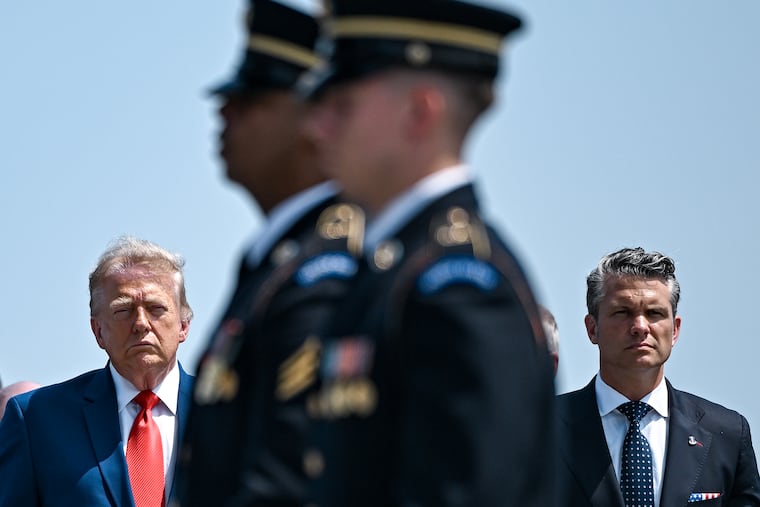
During a recent cable news appearance, Commerce Secretary Howard Lutnick claimed no American lives had been lost in the Iran war, an error he blamed on confusion with President Donald Trump’s earlier invasion of Venezuela. And perhaps it is difficult to keep one’s wars straight in an administration that has attacked seven countries in less than two years.
But while Lutnick’s claim was horribly wrong in fact, it was an accurate reflection of the administration’s consistently reprehensible diminishment of the costly war it started more than six months ago without congressional authorization or public support. The day after the secretary’s gaffe, Vice President JD Vance denied the very existence of the conflict, telling reporters, “I wouldn’t call it a war,” just days after an American bomb killed five civilians attending a wedding in southern Iran. The day after that, Trump himself dismissed the war as “small potatoes,” adding, “There’s no fighting,” even as the conflict continued to escalate, drive up energy prices, and threaten to draw in other countries.
In reality, the war has had tremendous repercussions for U.S. service members and civilians in the Middle East, American security and credibility, and global trade and stability. The only aspect of the conflict that is not serious is Trump’s handling of it.
» READ MORE: Fetterman’s shiftlessness is an insult to his office and all Pennsylvanians | Editorial
Despite the administration’s best efforts to obfuscate the human cost of the conflict, the war has killed 18 American service members and wounded nearly 800, taken thousands of lives in Iran and the Middle East, injured tens of thousands across the region, and displaced hundreds of thousands. And the fighting has likely cost American taxpayers more than $100 billion in direct spending, with energy and other economic repercussions that could approach $1 trillion in the United States alone.
The intangible costs aren’t small potatoes, either. Iran remains under the control of an emboldened regime able to fire on U.S. bases in the region, impede traffic through the crucial Strait of Hormuz, and resume its pursuit of a nuclear weapon without the international limits and monitoring Trump dismantled during his first administration.
The war has also depleted the military’s supplies of critical munitions, leaving us more vulnerable to adversaries, and strained our forces with marathon deployments and logistical disruptions. Rather than responding to these problems with the urgency they deserve, Defense Secretary Pete Hegseth appears preoccupied with hunting for those who disclosed them to the press, purging ranking personnel who might disagree with him, and blocking promotions of Black and female officers. The Army has lost half its four-star generals, its chief of staff, and its top civilian leader — Army Secretary Dan Driscoll — who reportedly warned the president of the force’s flagging experience, readiness, and morale on his way out.
» READ MORE: In Pennsylvania and across the nation, election deniers must be voted out | Editorial
Nor does the administration appear better prepared to end the war than it is to win it. Trump told the Republicans’ midterm convention Wednesday that the conflict was necessary to prevent an Iranian bomb and nearing its final stages. But peace negotiations have fizzled, the countries are exchanging strikes on warships and tankers, and Energy Secretary Chris Wright recently acknowledged that another deal on Tehran’s nuclear program may never be reached.
The trouble is that Trump and his lieutenants don’t appear to have a strategy for waging war on — or making peace with — Iran. What they have instead is a plan to manage the public relations fallout of the conflict by lying about its casualties, costs, and extent in the hope voters won’t punish their party for it in the midterm elections. It’s not even good PR, let alone defense or diplomacy.
In that sense, it’s not surprising Trump and Co. can’t figure out how to get out of the war they began. They would have to start by acknowledging they’re in it.