Memoir rooted in cherished, storied objects
After their mother died, Lisa Tracy and her sister Jeanne faced an embarrassment of possible riches. Over the course of generations their family had accumulated more chairs, chests, and china than could reasonably be used or stored.
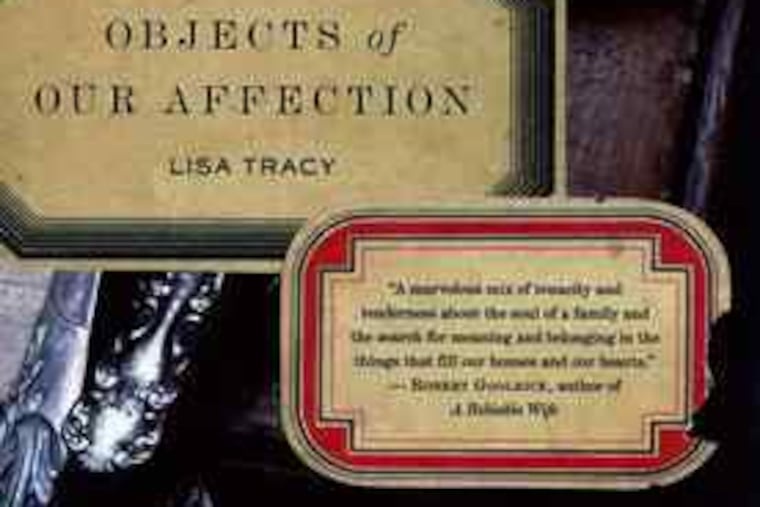
After their mother died, Lisa Tracy and her sister Jeanne faced an embarrassment of possible riches. Over the course of generations their family had accumulated more chairs, chests, and china than could reasonably be used or stored.
She had no idea what these objects might be worth, so Tracy set out to document what she and her sister owned and then sell what they could. In the process, Tracy discovered how little she knew about her ancestors and their objects.
Her quest took Tracy from Philadelphia to the Philippines by way of Kentucky, Ohio, and South Dakota, and resulted in a memoir, Objects of Our Affection (Bantam Books, $25), an artful exploration of inheritance and identity. Tracy will be reading April 15 at Moonstone Arts Center, above Robin's Bookstore on South 13th Street.
The book tells a story that is particular to Tracy's family, but the conundrum she identifies - what we keep and why - is a common concern.
Two of the most popular programs on public television are Antiques Roadshow and History Detectives. In restaurants and home kitchens, there's new appeal in lost recipes using heirloom ingredients. In publishing, memoirs continue to be best-sellers. And at flea markets, everybody's either buying or selling old stuff.
"We look to moor our identities in things of the past," says Seth C. Bruggeman, who teaches public history at Temple University.
"We define who we are by the objects we choose to value," Bruggeman says. "We have an almost religious belief in the power of objects to convey meaning."
Tracy notes the irony.
" . . . these days people go out and buy old photographs, other people's photographs, because they want to have old photos sitting on their tables," her sister Jeanne muses in the book.
The Tracys were a military family, always on the move. Having their own chairs and tables and beds at each new location helped establish those places as home. Clearly, the family furniture was imbued with emotional value.
But an auctioneer she hires tells Tracy that knowing each object's provenance could boost its monetary value. And as we follow Tracy on the rounds of historical societies, we wonder which objects will be winners.
Will it be the chair George Washington may or may not have occupied, the Canton china, the napkin rings from West Point, deeds signed by William Penn, a 1786 embroidered sampler, or a pair of pistols that were owned by Aaron Burr, but which were not the pistols he used to shoot Alexander Hamilton?
More significant, Tracy discovers that her grandparents had a child with Down syndrome referred to only as "little brother."
"His existence was not alluded to or discussed. In those days, there was great shame connected with deformities and illnesses people did not understand," Tracy said in a recent interview from her home in Virginia. "It's just so tragic for everyone who lived through that."
She also learned that her mother's older brother died at age 7 or 8 onboard a ship that was taking the family from a post in the Philippines back to the U.S. Her mother would have been about 2 at the time.
"People just didn't discuss those incidents then," Tracy says. "I don't think my family is unusual in that respect at all."
Tracy finds that her forebears were often at the forefront of history, rubbing shoulders with (or taking orders from) Washington, Thomas Jefferson, William McKinley, Theodore Roosevelt, Douglas MacArthur. Various relatives fought in the Civil War and in Cuba, at San Juan Hill. Others were witness to the Boxer Rebellion, and at Wounded Knee - but she laments that they were on what would be seen today as the wrong side, upholding imperialist ideals.
The estate sale itself does not substantially enrich the family coffers. But by then Tracy is more focused on the stories behind the objects, and haunted by lost opportunity.
"We are taught to indulge our elders by listening to their stories," she writes. Instead, "we should listen to their tales for what they might tell us of ourselves."
When her mother was alive, Tracy writes, "I didn't ask the questions that might have elicited the stories, and so, like many of us, I am left with pieces to quilt together with the thread of surmise."
A museum curator deciding what to add to a collection considers whether an object's backstory is known, Bruggeman says. An individual has to do more than know the backstory, Tracy says.
So when she is asked how long one is obliged to keep an inherited Chippendale chair or an old Army medal, Tracy finally has an answer.
"We can never be free of our possessions," Tracy writes, "until we have dealt with the stories they carry."