City woman addresses school crisis by opening her own
Katharine Savage is a devoted city dweller, a believer in public education who joined a civic group devoted to improving the neighborhood school she imagined her three children would someday attend.
Katharine Savage is a devoted city dweller, a believer in public education who joined a civic group devoted to improving the neighborhood school she imagined her three children would someday attend.
But as she watched budget battles erode programs in the Philadelphia School District, Savage balked and began to explore different paths.
"I didn't want to base my children's education on a politician's whims, and I didn't have much faith that public schools would sustain my kids over the long haul," she said.
The city's elite private schools were too pricey. There was no guarantee her children would get into charters. And Savage dreamed of a curriculum rooted in the classics, much like her own education.
So she channeled her energy and fund-raising efforts into opening her own school. Backed by a board of young professionals, the Philadelphia Classical School opened in rented church space at 17th Street and Washington Avenue in September. The private, Christian school is tiny - just 21 students in kindergarten, first, and second grades - but growing, fielding steady requests for tours and applications for next school year.
With no end in sight for the public schools' problems, many parents who have other options are exercising them.
Savage, 34, has no background in education. She is a dancer who studied philosophy and dabbled in grant writing. But she was drawn to classical education, a centuries-old approach to learning that emphasizes grammar, writing, and debate. Students read the classics and learn Latin. Memorization is key in the early grades. Later, pupils don't just learn who Aristotle was. They read Aristotle's writings.
"I said, 'Let's create something. I think we can do it,' " said Savage, who lives in South Philadelphia. Over four years, she assembled a team, established a nonprofit, raised money, visited other classical schools, recruited students, and, two months ago, opened the doors on her dream.
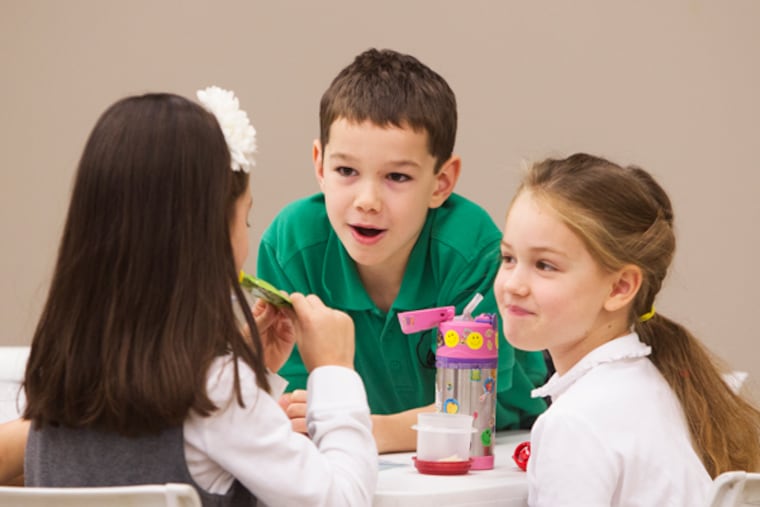
On a recent morning, the whole school gathered for opening activities, singing about U.S. presidents, state capitals, and ancient history as one parent volunteer strummed a guitar and another instructed the group in musical dynamics.
In Kristen Morrison's first- and second-grade class, students recited sentence jingles, triumphantly trumpeting that "an adverb modifies a verb! An adverb asks, 'How, When, Where?' "
The school aims to tweak the traditional classical model, encouraging regular visits to sites around the city to amplify classwork, and spicing up staid songs with drums and dance. Scholarship is serious but doled out in short blocks. Play is encouraged, and tests, while administered, are de-emphasized.
"One parent told us that at their old school, their child had 12 minutes to eat lunch," said head of school Ross Hatton, a former Philadelphia School District teacher. "That's not enough time. He was stressed."
Tuition ranges from $1,500 to $12,000, depending on family income, with 40 percent of spots reserved for low-income students. Currently, tuition funds a little less than half the school's $250,000 budget. The rest comes from fund-raising - grants and individual donations.
Families come from all over the city to attend the school; some are Christian, some are not.
Though certification is not required for private school teachers, Philadelphia Classical's are certified, and they must live in the city.
As a religious school, Philadelphia Classical does not need a license to operate, but its leaders say they will work toward accreditation by the Association of Classical Christian Schools. It must ensure only that pupils attend at least 900 hours of school a year.
The school's size forces economies. Savage teaches dance; Hatton is the gym instructor. When Latin instruction begins for next year's third graders, Morrison will teach it.
Choosing Philadelphia Classical was a leap of faith for Daniel Lee, who for years never considered an alternative to his high-performing neighborhood public school. But in the spring, a few months before his daughter was set to enter kindergarten, news of another budget crisis hit.
Lee, an architect, and his wife, Grace, a physician, were stunned. Brace yourselves for bigger classes and no support staff, they were told. They were asked to contribute money to rehire a counselor, a librarian, a dean of students.
"It became an untenable situation," Lee said. "There were a lot of frustrated parents, and there didn't feel like a lot of solutions. The city's not making it easy for families to stay."
He and his wife heard about Philadelphia Classical. They researched the model and decided to give up their spot at Meredith Elementary, even though the new school was unproved.
The Lees are delighted with their daughter's education so far. She astonished her father a few weeks ago by correcting him gently when he looked at a $10 bill in his wallet and mused about when Alexander Hamilton was president.
"She said, 'He wasn't a president, Daddy,' " Lee said.
Equally pleased is Jodie Tallman, who decided to forgo her daughter's seat at well-regarded Greenfield Elementary in Center City for Philadelphia Classical.
Tallman, a stay-at-home mother, and her husband, Bryant, who works in finance, recently moved to Center City from Colorado and had heard great things about their local school.
"But the classes felt too big," Tallman said. "It just didn't feel like a good fit."
Savage and Hatton - and the families they serve - don't feel as though they're abandoning the public school system. There aren't enough good choices for city dwellers, they say, and their efforts are helping that cause.
Plus, Savage said, "we're not siphoning money off from the public schools. We need big solutions, and this is one."
Hatton nodded.
"I plan to live in this city for the rest of my life," he said. "We need good public schools."
215-854-5146 @newskag