Michelle Caffrey was in a hurry. She threw on a hoodie and ran out the door of her Westampton home.
"When I got to work and sat down at my desk, I felt a little itch on my chest," she said.
Out crawled a huge stinkbug.
"As per the usual finding-live-insect-in-my-clothes reaction, I screamed, threw it on the ground, killed it, and have vowed revenge ever since."
So the Burlington County woman will hardly be delighted to learn that this year is shaping up to be a banner year for stinkbugs.
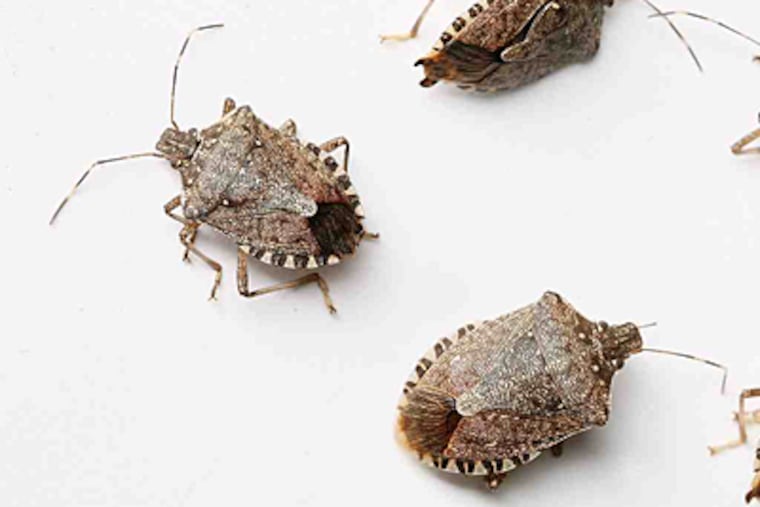
The shield-shaped pest, an invader from Asia, has developed into a major household nuisance with a high gross-out factor, dive-bombing dinner guests from the chandelier, crawling across bed pillows at night, and doing the backstroke in cups of tea.
For farmers, it's a potential catastrophe.
The stinkbug has become a formidable agricultural pest, costing growers of apples, peaches, corn, soybeans, and more millions.
Last year, Pennsylvania's $69 million apple industry took a 25 percent hit. Things weren't any better in the Garden State.
Compared with that, the homeowners have it easy. The insects don't bite, transmit disease, or chomp away at the floor joists. But they do buzz annoyingly, leave brown trails of excrement, and emit a stinky odor when squished.
The United States has several native species of stinkbugs, and some are beneficial. But this one - the brown marmorated stinkbug - is native to China, Korea, and Japan.
Discovered in Allentown in 1996, it has since been detected in 33 states. But its stronghold is the Mid-Atlantic.
In Asia, natural predators keep it in check. Here, it has none.
Entomologists had hoped the enemies that attack native stinkbugs might adjust their diets and control the Asian invaders.
Alas, "they try, but they're not good enough," said Kim Hoelmer, a research entomologist at a federal agriculture invasive-pest lab in Newark, Del.
Researchers are amazed at the broad range of host plants - more than 300.
Last year, the insects went after soybeans, tree fruit, tomatoes, peppers, sweet corn, field corn, grapes, and raspberries, said George Hamilton, a pest-management specialist at Rutgers University.
The insect inserts its needlelike mouth parts and sucks out the juice.
Left behind is a corky, dry dent, which nixes any chance of selling the fruit as is.
Growers can send the fruit to be juiced or made into applesauce, but only by taking a financial hit. A bushel of apples that sells for $20 to $40 on the fresh-food market will fetch only $5 or less once scarred by the stinkbug.
Two years ago, Ed Weaver, owner of the 100-acre Weaver's Orchards in Morgantown, Berks County, saw very few stinkbugs.
Last year, as much as 15 percent of his crop was damaged. Even so, he felt lucky. Some growers had losses of up to 80 percent.
"I have growers who basically told me that if we have another two years like 2010, they will be out of business," said Greg Krawczyk, a fruit entomologist at Pennsylvania State University.
Some agricultural insecticides will kill the bugs, but they also kill the beneficial insects. Weaver, like many farmers, has limited his use of those chemicals.
So the search is on for a better fix.
At a U.S. Agricultural Research Service lab in Beltsville, Md., chemist Aijun Zhang has been trying to discover the stinkbug's pheromone - a chemical that attracts others of its species.
His work is critical in developing traps to detect or capture the bugs.
After four years, he finally thinks he has found it. But he still must discern the chemical structure and figure out how to replicate it.
In Hoelmer's Delaware lab, entomologists are working with a microscopic species of parasitic wasp that attacks stinkbug eggs. They collected it in Asia.
Now, under heavy quarantine, the researchers are tempting the wasp with potential native edibles. They have to prove it won't attack anything other than brown marmorated stinkbugs.
Other scientists are seeking more enemy agents, from natural pathogens to fungi.
Not a moment too soon. Some predict the bugs will be worse than ever this year.
Usually, the insects have one generation of young in a year. In 2010, in some areas, the prolific insects had two.
"We saw much higher levels all over the Mid-Atlantic last year than we did in the previous 10," said Rutgers' Hamilton. "I think they hit a critical mass and exploded."
When it comes to homes, there's not much to be done.
Some people apply pesticides to windows and eaves, with mixed results.
The green industry has had better luck. Homes that have been insulated and caulked for energy savings also seem to have fewer stinkbugs.
At least the insects are good for one thing. People seem to relish tales of close encounters.
Brett Domergue of Phoenixville recently brewed a cup of coffee, poured it into a to-go mug, and took a sip. It tasted foul and stale.
He looked down and saw a stinkbug crawling out of the sip slot. "Take my advice: As far as coffee mixers go, stick with milk and sugar," he said.
Leslie Wooding of Kennett Square has found a fitting way to get back at the insects. She feeds them to her chameleon, Zeus. "It's nice because they crunch. You can hear that he's caught one."
Those who live near fruit trees seem to receive a bounty of the bugs. One woman who lives next to a Chester County apple orchard vacuums them up by the hundreds come summer. Recently, one of the insects fell into her pancake batter and she almost ate it.
Worried about a stinkbug stigma, her husband demanded that she not be identified for this article.
By now, Julie Odell of Roxborough has made peace with stinkbugs. There were so many, she simply had to. "I don't freak out any more."
She has even come to appreciate their beauty. "They've got this really elaborate pattern on the shell. Like a coat of arms," she said.
Then again, one recent night she woke up and drank from the glass of water she leaves at her bedside. (Cue the monster music.)
"People who don't have them don't know what you're talking about," she said. "The rest, it's a club of commiseration."