Democrats pick new Senate candidate in Maine in aftermath of Platner debacle
The Maine Democratic Party formally selected former legislator Troy Jackson as its new Senate nominee on Saturday, ending three tumultuous weeks
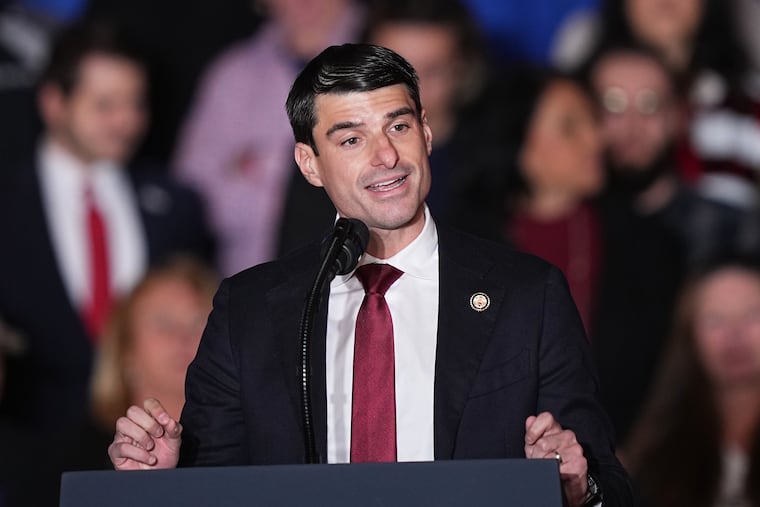
BANGOR, Maine — The Maine Democratic Party formally selected Troy Jackson as its new Senate nominee on Saturday, ending three tumultuous weeks that nearly derailed the party’s quest to unseat veteran Republican Sen. Susan Collins.
With just 101 days remaining until the November election, Democrats must now unify a party riven by the spectacular collapse of Graham Platner’s campaign following a sexual assault allegation and refocus attention on the long-indomitable Collins, whose defeat is key to long-shot Democratic hopes of retaking control of the U.S. Senate.
Accepting the nomination from a convention center in downtown Bangor with a 31-foot-tall statue of Paul Bunyan outside, Jackson repeatedly framed the election not as a partisan fight but an opportunity for the working class to stand up to a creature of Washington who had grown more loyal to her corporate benefactors than her constituents.
“This movement is not from the left. It’s not from the right,” he said, as supporters waved “Retire Susan” signs in the crowd. “It’s from the bottom — and we are growing.”
Jackson is a 58-year-old logger and former leader of the Maine Senate who aligned with Platner and Sen. Bernie Sanders (I., Vt.) during an unsuccessful run for governor this year.
He won the nomination by commandeering the progressive movement that had propelled Platner. Jackson’s supporters swept the delegate selection process for a hastily organized convention to choose Platner’s replacement, compelling most of Jackson’s rivals to drop out ahead of the meeting Saturday in Bangor.
Jackson’s challenge is to forge a broad coalition that can win in November, including the independent and crossover Democratic voters who have helped Collins hold on for five terms in an increasingly blue state.
Jackson has his own vulnerabilities — including a long history of opposing abortion rights and a temper that undercut his legislative leadership in Augusta — that could hurt his appeal with women voters who have been critical to Collins’s victories. He has also been reluctant to align with the national Democratic Party, which could provide critical resources in a marquee race.
Ahead of the convention, Democratic-leaning voters in Bangor remained wary of Jackson but highly motivated to beat Collins.
“Progressives and Democrats are often put in this position where we have to vote for whoever is put up against the greater evil,” Molly Wunderli, a 36-year-old graphic designer, said Friday as she left the library downtown.
An unenrolled voter who considers herself to the left of the Democratic Party, Wunderli expressed frustration that Platner was not properly vetted and about the rushed process to choose his replacement, which put the decision in the hands of just 600 people. But given the stakes, she said there was no question she would vote for Jackson in November.
“I hope he’s as advertised,” Wunderli said. “I’m always worried now about the other shoe dropping.”
The campaign has been clouded since the beginning by a bitter ideological battle among Democrats. While the national party establishment recruited Maine Gov. Janet Mills to run, the progressive base in Maine rallied around Platner, a combat veteran and oyster farmer whose populist outsider platform electrified liberal voters.
Mills’ candidacy fizzled before the June primary, even as Platner was beset by an escalating series of scandals that he largely attributed to poor mental health following his military service: old social media posts dismissive of sexual assault, a tattoo resembling a Nazi symbol, sexually explicit text messages he sent to other women after he married, and allegations by ex-girlfriends who described volatile relationships with him. Efforts by national Democrats to push Platner aside only infuriated his supporters, and he won the nomination handily last month.
Then came an accusation of sexual assault from a woman Platner used to date, which he has denied. Under pressure from allies and threats from national Democrats to withhold financial support, Platner withdrew on July 10, setting off a scramble to find a new Democratic candidate.
That was demoralizing for progressive Democrats like Percy Williams, a 29-year-old middle school English teacher from Bangor. She was excited not only by Platner’s policies but also a persona that she believed carried a wide appeal in Maine.
“Some of my family members are Republicans, and they liked him because he talks like them,” Williams said.
While she had hoped Secretary of State Shenna Bellows, another unsuccessful gubernatorial candidate this year, would replace Platner, Williams said she came around on Jackson because “he’s the best that has a shot at actually winning.”
The Platner scandals still cast a pall over the race — and Collins will inevitably try to tie Jackson to the man with whom he shared such close political ties.
A Republican super PAC released its first ad on Saturday, highlighting Jackson’s temper and history of clashing with female colleagues. “Troy Jackson is like Graham Platner, but worse,” the narrator warns.
Jackson never mentioned Platner during the convention, but he did nod to the concerns about his anger. He was introduced by a former state legislator he once fought with, who praised his passion. Jackson told reporters later that “I do wear my heart on my sleeve,” but he always apologized to “anyone that I may have argued with that I might have went too far.”
But even Democratic voters unenthusiastic about Jackson are furious at Collins. A common criticism is that Collins, who presents herself as a moderate who will stand up to President Donald Trump, only breaks with him on votes that she knows Republicans will win anyway.
“She’s had multiple opportunities to be a Margaret Chase Smith and stand up for what’s right,” said Frank Bragg, an 85-year-old retired physician, referencing the former Maine senator who delivered a famous floor speech in 1950 denouncing McCarthyism. “And she’s just gone along with Trump.”
Bragg pointed to Collins’ support of the Save America Act, a Trump priority that would require photo identification to vote and roll back most mail voting, despite Maine overwhelmingly rejecting a similar ballot measure in November.
A Republican-turned-Democrat who once supported Collins in her early elections, Bragg said he appreciated what the senator had done for Maine, “but it’s also about standing up for the country.” He will vote for Jackson in November, though Bragg considers him “sort of another machine politician. It’s a bit of the same old, same old.”
With his nomination essentially sewn up before the convention, Jackson has already begun consolidating Democratic support in Maine and shifting his message to attacking Collins.
He secured endorsements from most of his opponents for the Senate nomination ahead of Saturday, as well as from Hannah Pingree, who defeated Jackson in the gubernatorial primary in June. Social media accounts for his campaign are pumping out posts slamming Collins for her closeness to the Trump administration and for confirming to the Supreme Court Brett M. Kavanaugh, who provided a decisive vote to overturn the constitutional right to abortion.
But an ongoing rift with national Democrats could complicate the campaign. Despite his extensive history in elected office, Jackson is, like Platner, running as a disrupter — emphasizing his roots in conservative northern Maine while favoring progressive policies to rein in corporate power, expand healthcare access, and dismantle U.S. Immigration and Customs Enforcement, the controversial federal agency involved in a fatal shooting in Biddeford this month.
Jackson told the New York Times this week that, if elected, he would not support Sen. Chuck Schumer (N.Y.) continuing as Democratic leader of the Senate. He also expressed doubt about accepting help from Schumer, who has thus far declined to endorse Jackson, in the general election.
That could be an enormous handicap for Jackson, who is not a prolific fundraiser. Conservative groups have already lined up tens of millions of dollars to defend Collins.
Elizabeth Hannigan, a 33-year-old data analyst from the Bangor area, recalled seeing a Collins ad nearly every commercial break during the World Cup, touting all of the money she’s brought home to Maine. Hannigan said she worries whether Jackson will have enough time to mount a victorious campaign.
She wants Jackson to “get the national party behind him, not just the Sanders wing.” Hannigan, who considers herself to the center of the Democratic Party, said it would provide a signal of trust; she does not want to elect another Sen. John Fetterman (D., Pa.), a onetime progressive champion who has increasingly broken with his party since he arrived in Washington in 2023.
“I want someone who will vote with the general Democratic agenda,” Hannigan said.