Amid a ‘painful trail of incidents,’ a disciplinary court weighs whether Philly Judge Scott DiClaudio can remain on the bench
The state Judicial Conduct Board said Common Pleas Court Judge Scott DiClaudio should be removed from the bench. DiClaudio asked for mercy.
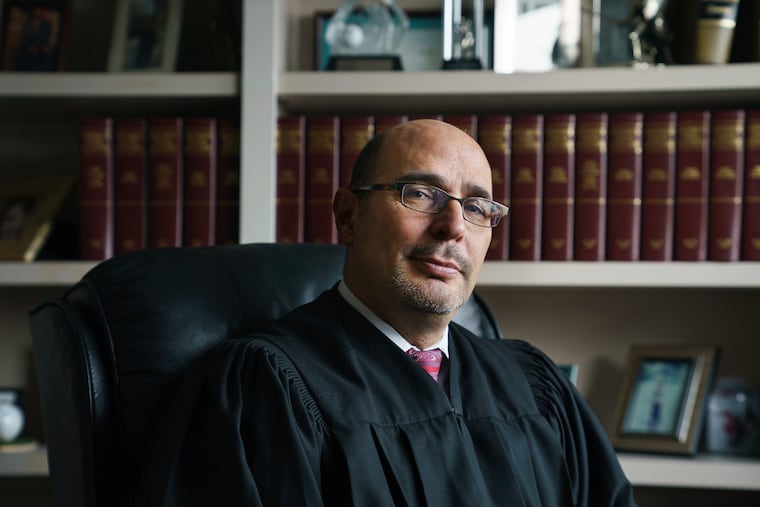
HARRISBURG ― Pennsylvania’s Judicial Conduct Board on Thursday urged a judicial disciplinary court to permanently remove a Philadelphia judge from the bench, saying he had displayed a pattern of unethical and “boorish” behavior that culminated in an effort to influence a colleague’s decision in a criminal case last year.
Common Pleas Court Judge Scott DiClaudio showed “little respect for the court and little respect for the rules of the court,” said Elizabeth Hoffheins, deputy counsel for the Judicial Conduct Board.
DiClaudio had a history of disciplinary issues, she said, and he had not taken adequate responsibility for his actions.
“Anything less than removal would fall short of restoring the public’s trust,” Hoffheins said.
The board’s request came after two days of testimony before the Court of Judicial Discipline, which is expected to determine DiClaudio’s fate as a judge in the coming months.
DiClaudio acknowledged Thursday that his remarks to fellow Common Pleas Court Judge Zachary Shaffer were improper, but insisted it was a complete misunderstanding and was never meant to tilt the scale of justice.
“I wish I never said it. I regret ever saying it,” DiClaudio said of the comments to Shaffer. “I wasn’t thinking.”
Shaffer testified that he was on the bench in his courtroom on June 12, 2025, when DiClaudio’s personal assistant, Gary Silver, walked in and said DiClaudio wanted to see him.
Shaffer said he and his clerk, Nicole Vernaccio, had been in touch with DiClaudio that week about buying T-shirts from the cheesesteak shop owned by DiClaudio’s wife. They assumed the request was to go pick them up.
The two walked to DiClaudio’s courtroom, then gathered in his robing room. They spoke for several minutes about various topics, he said, before DiClaudio asked Vernaccio to leave. Vernaccio also testified that she was asked to step out.
Shaffer said DiClaudio then pulled out a piece of lined paper with “Dwayne Jones, courtroom 905, and Monday’s date” written on it.
DiClaudio held it out at his side, he said, then looked at him and said, “OK?”
Shaffer said he was confused, and hesitantly said, “OK.”
He said DiClaudio ripped up the paper and threw it away.
As Shaffer started to leave, he said, DiClaudio told him: “‘You probably would have done the right thing anyway.’”
Shaffer said he was shocked and believed DiClaudio was suggesting he should give a favorable sentence to Jones, who was scheduled to appear before him in the coming days on illegal gun-possession charges connected to a fatal shooting.
Shaffer reported the conversation to his supervisors the next morning, and they referred the matter to the Judicial Conduct Board. He recused himself from Jones’ case.
The board charged DiClaudio with multiple ethical violations last September. He was later suspended without pay.
DiClaudio’s testimony during a hearing last fall and again this week clashed with Shaffer’s in nearly every way.
All of this came to be, DiClaudio said, after he attended the Roots Picnic last June — where he said he hung out backstage with Philadelphia rapper Meek Mill. In the common area, he said, Jones approached him and said he had an upcoming sentencing before Shaffer.
DiClaudio said he didn’t know Jones, and only told him that his colleague was “a good judge who would do the right thing.” When Jones handed him his business card, he said, he put it in his wallet, not wanting to be rude.
DiClaudio denied that he later summoned Shaffer to his courtroom, despite an audio recording that showed that shortly before his assistant went to retrieve Shaffer, DiClaudio asked: “Is Judge Shaffer on the bench right now? Can you call down there and see if he’s still on the bench please?”
DiClaudio said he only asked about Shaffer because he had just addressed a case where a defense attorney Shaffer is dating didn’t appear in court. He said he wanted to ask Shaffer why she didn’t show. (The courtroom audio confirmed that DiClaudio addressed the woman’s case just before inquiring about Shaffer.)
He said he didn’t instruct Silver to visit Shaffer, and was surprised when the judge walked in.
Once inside the robing room, DiClaudio said, he, Shaffer, and the clerk discussed various topics. It was only as Shaffer went to leave, he said, that he picked up his phone and wallet holding Jones’ business card, and remembered the concert exchange.
He said he took out the card and told Shaffer: “I saw this guy at a concert. I told him you’re a good judge and you’d do the right thing.”
Then, he said, he tossed it into the trash.
“It was improper and wrong. There was no good reason to say that even though it wasn’t my intention to influence the case,” he said Thursday, adding: “I never wanted him to do anything with that statement other than to say thank you.”
The board had initially said that DiClaudio sought to sway the case because Jones was a friend of Meek Mill. Jones, in an interview last year, also said he was a friend of the artist’s.
DiClaudio, too, is close to Mill.
But Hoffheins did not introduce evidence of that during Thursday’s hearing. She said this week that the board still believed that to be true, but did not need to prove a motive in its case.
“This remark was not simply a compliment, not simply an off-the-cuff remark,” she said. “It was calculated to occur three days prior to this man’s sentencing.”
DiClaudio was elected to Philadelphia’s Court of Common Pleas in November 2015, and took the bench in January 2016. Before his suspension last year, he mostly heard cases filed by people seeking to have their murder convictions overturned.
He presided over many high-profile exonerations and wrongful-conviction cases, and approved the release or resentencing of dozens of people who had been serving life in prison.
DiClaudio was known for working long hours, moving cases efficiently, and thoroughly explaining his decisions to the families of victims and the defendants. But he was also unconventional in his at times brash communication style on the bench.
That was on display again Thursday. He often rambled in a stream of consciousness from the stand, breathlessly veering between accepting responsibility, refuting Shaffer’s testimony, and even relaying his colleague’s dating history. His attorneys, Samuel Stretton and George Bochetto, struggled to reel him in.
“Just stop,” Stretton interjected several times.
Hoffheins pointed to the display, as well as DiClaudio’s previous disciplinary record, as proof of a pattern of misconduct.
Before becoming a judge, DiClaudio was censured by the Pennsylvania Supreme Court for “serial misconduct,” including violating legal ethics rules. Shortly after he took the bench in 2016, Hoffheins said the Judicial Conduct Board sent him a private disciplinary letter for engaging in “boorish behavior” toward his court staff.
Then, in 2020, the Court of Judicial Discipline determined that he violated the code of conduct for judges when he failed to report debts on annual financial disclosure forms and repeatedly defied a judge’s orders to pay thousands of dollars in overdue bills to a Bala Cynwyd fitness club. He was suspended for two weeks, and placed on probation through 2026.
And last April, the Judicial Conduct Board accused him of using his position as a judge to promote his wife’s cheesesteak shop, eroding public trust in the judiciary and abusing the prestige of the office for personal gain. DiClaudio has denied the allegations, and the case remains ongoing.
“What I am hearing, what I am feeling, is a persistent theme of your doing things and saying things … that are not wise," said Judge Charles L. Becker, of the disciplinary panel.
Judge Carolyn Nichols called it “a painful trail of incidents.”
In a final plea, DiClaudio, 63, said if he returned to the bench, he would only work the few weeks necessary to secure his pension and lifetime health insurance to support his wife and two young children. Then he would retire, he said.
He teared up as he spoke of his children and defended his integrity and career.
“I talk a lot but it’s my greatest strength and my greatest weakness,” he said. While he might be a “crazier judge,” he said, he’s “a judge who makes the right decisions.”
“That may be an explanation,” Becker said, “but frankly, I’m not sure that’s a defense.”
Stretton, in his closing remarks, asked the panel for mercy.
“Yes he did something bad. And some of his conduct here can get a little rambunctious,” he said. “... But I see a great, decent judge. He’s done a lot of good in the community and on the bench. He’s well-respected.”
The tribunal will now weigh the matter, a process that could take months.