Lower Merion shut down a school board meeting amid shouts from parents angry about tech use
A school board committee on Monday advanced new rules on when screens should be used in classrooms. The full board will vote on the regulations later this month.
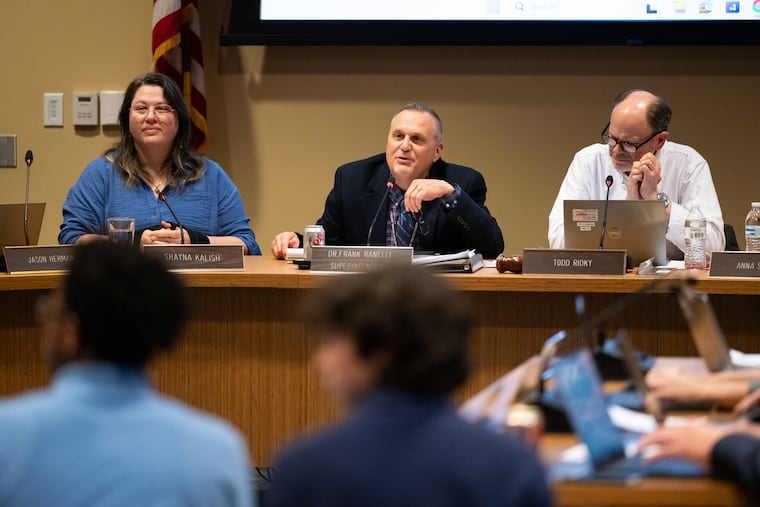
A Lower Merion school board committee on Monday advanced new rules on when screens should be used in classrooms, while facing anger from parents who want more limits on technology.
The policy committee, which has been hammering out a technology policy after parental backlash to excessive screen time, went into recess and later shut down its meeting in the district’s administrative offices in response to shouts from people in the crowd.
“When you are disrupting a public meeting, you are actually breaking the law,” school board president Kerry Sautner said, as a parent in the crowd, David Smyth, called on the committee, which had stopped public comment after 45 minutes, to allow more people to speak.
Sautner — who said earlier that 45 minutes was typical for the committee’s public comment period — told Smyth he could leave, or stay and listen. When he answered that he wanted more public comment, the committee ended the in-person meeting and switched to Zoom to vote to advance the policy.
The policy now goes before the full school board for a vote on Aug. 17. It sets new guidelines for how technology is to be used in Lower Merion, one of the Philadelphia area’s most affluent districts, amid a national debate over whether excessive technology use is impairing kids’ educations.
Lower Merion’s proposed policy scales back on screens for the youngest students — specifying that kids in kindergarten and first and second grades will not be issued individual devices. Previously, kindergartners and first graders were given iPads, while second graders received Chromebooks.
“Many of you came and said, ‘I don’t think my kindergartener needs a one-to-one device.’ I don’t disagree with you,” Superintendent Frank Ranelli said at Monday’s meeting.
Under the proposed policy, any technology use for K-2 students “shall be minimal, highly structured, and limited to specific educational purposes.”
Students in third and fourth grades will not have personal devices, but will have “an assigned log-in” that they can use to access computers on classroom carts, according to a district spokesperson, Amy Buckman.
In grades five and six, students will be assigned devices but will not bring them home unless their parents want them to, Ranelli said.
While bringing computers home becomes the default by seventh and eighth grade, Ranelli said, students who choose not to do so will not be penalized.
But, the superintendent said, families “cannot decline technology” in the new policy — a bitter point of contention throughout school board debates earlier this year, as families demanded to opt out of devices.
The board voted in June to scrap its former policy, which contained language requiring the district to serve families who did not consent to being issued a computer. While more than 800 parents signed a petition supporting the right to opt out, Ranelli said doing so was not possible.
Parents have continued to organize under a Pencils Over Pixels group.
At Monday’s meeting, Matthew Posey, a district parent, read from an April 9 email obtained through a Right-to-Know request, indicating that Ranelli had “instructed” Sautner to repeal the policy, according to Posey.
“We also want to make sure … that the board sees the vision in not allowing parents to totally ‘opt out’ of getting a device and having to use it for part of our curriculum,” Ranelli wrote, describing the district’s response to parental concerns.
Replying the next day, Sautner told Ranelli: “Got it.”
“We do not pay premium local taxes to have this insulting, rubber-stamp school board governance,” Posey said. He accused the board of treating months of public meetings over technology use as “an inconvenience to be managed,” rather than a genuine consideration of parental concerns.
Sautner said that she would have to review the email Posey mentioned, but that she sometimes responds “got it” to indicate she has received a message.
“We hold the superintendent accountable,” she said. “It is literally our job as the board.”
Parents pressed the committee for answers Monday on how the policy would work in practice. Ranelli said the district had been training principals in a “default to off” philosophy, to instruct their teachers to tell students that if they are not actively using their computers for an activity, “we want your screens to be down. Or we don’t want them at their desks.”
While rules accompanying the policy include some guidelines for how much screen time kids should be getting each day — from 30-45 minutes in third and fourth grades to up to 90 minutes in fifth through eighth grades — there are no parameters for high school.
School officials said that was too difficult, given how many classes high school students have in a given day.
“I want to make sure we’re not handcuffing the teachers,” Ranelli said.
Ranelli also said the district had stepped up efforts to block inappropriate websites, including all Google sites, which kids had used to play games, he said. It has also blocked all streaming services and AI summaries, Ranelli said.
He said the district — and parents — would be able to better monitor kids’ online activity through a new Securly program, which allows teachers to monitor what kids are looking at in class. Parents, meanwhile, can block more categories of websites and set schedules for their kids’ devices out of school hours, Ranelli said.
Smyth, the parent whose interruptions led the board to end the meeting, said in an interview that parents feel like board members are “checking a box and not really interested” in their comments.
“In our mind, the big sin is really one-to-one devices,” said Smyth, who has children in seventh and eighth grade. He had planned to ask if the district will be tracking time spent by students on various computer programs — to set metrics for “what would have them reconsider” the amount of technology use in classrooms.

Inquirer Lower Merion