In Nolan’s ‘Odyssey,’ food and feasting are vehicles for disgust. What a shame.
Nolan's interpretation is visually arresting, but not when it comes to food. Our food reporter, who is also a classics scholar, tells us how to watch the movie and dine like a hero.
It is immensely exciting to me that right now, everyone is talking about The Odyssey. It’s also a little weird.
I studied classics in graduate school and before I became a chef and then food writer, I taught Ancient Greek language and Greek and Roman epic poetry both in their original languages and in translation. I traced how Odysseus became Ulysses and how his story was retold through the ages, particularly in other forms of epic poetry. In my everyday life and at The Inquirer, nobody in the last decade has asked me about epic poetry, except for college students wanting help with their homework.
But I’ll tell you how I felt about Nolan’s version of the poem.
I felt hungry.
In Christopher Nolan’s blockbuster movie, Odysseus’ men slurp up what look like tapeworms as the witch Circe, played by Samantha Morton, forcibly manipulates their faces, pulling their mouths into the form of pig snouts. She molds their faces and bodies like clay until the men are transformed into pigs, the animals that best represent their brutish, stupid behavior.
It’s brilliant, stomach-churning, and wild, an extraordinarily visceral adaptation of the original Homeric text. It’s one of the rare scenes in Nolan’s adaptation of The Odyssey where one sees actual food, despite the food being wholly unappetizing.
Reading The Odyssey, though, makes me crave cheese and cakes that have been drizzled with honey, wine to wash down roasted meats like lechon or porchetta, sharing in the heady scent with friends, dining companions, and the gods, for whom the savor (or the aroma) is an offering.
Watching Nolan’s movie also makes me long for those things, but due to their general absence. None of the food portrayed is conducive to conjuring up the pleasurable excess that is the very drumbeat of the Homeric text.
In Nolan’s Odyssey, food and feasting are vehicles for disgust.
The film is undoubtedly a cinematic masterpiece. It is the latest iteration — and I would even venture, translation — of Homer’s Odyssey.
Back in eighth- or ninth-century BC, the bard, poet, or perhaps multiple bards, created what would be the longest-running superhero franchises of all time, matched only by the authors of the Old Testament. (And the two texts have a lot in common in how they were assembled, with language cobbled together from different eras).
In both translation theory and storytelling, we can accept variances. In superhero movies and movie franchises, we welcome them.
We can accept different actors playing the same roles. We eagerly anticipate actors’ interpretations of classic characters — just think of how we hunger for news of who will play the next James Bond or Batman.
Translation theory generally dictates translations need to be updated every generation or so, to match the language of the times. The French philosopher Jacques Derrida saw translation as a never-ending process. It is a task that is necessary and impossible at the same time, he wrote in “Des tours de Babel” in 1985, as language has no fixed, stable meaning.
Did I expect Nolan’s Odyssey to hew to the text? I did not. But what I did long for was emotion and catharsis (Aristotle’s theory of which was developed four centuries after The Odyssey was composed), and food. I also hoped for a narrator, or bard tying the story together, conveying it to us, an audience at a feast.
The lack of a narrator shows how much we have changed in nearly 3,000 years. Nolan’s Odyssey is episodic; he doesn’t tell us a story, he shows us one. We no longer gather at dinner and listen to stories performed. We gather for The Odyssey at movie theaters, silent. We gather at our phones. Our community is in the ether.
Perhaps in the age of TikTok and ever-shortening attention spans, Nolan’s episodic, somewhat disjointed retold narrative is perfect. It is our generation’s translation. The one we deserve.
Just as sex has been expunged from Nolan’s Odyssey, so have the food and Homer’s lengthy descriptions of feasting. Food is central to the original text. In the movie, I recall a suitor gnawing on one drumstick. There is no free-flowing wine, just drunkenness — effects of the invisible wine.
I dare you to pick up Emily Wilson’s translation of The Odyssey (which helped inspire Nolan) and not smell the smoke of roasting pigs; not want to lick your fingers of dribbles of floral, fragrant honey; not ache for a creamy, salty cheese like ricotta salata, which was probably what is hanging in the Cyclops’ cave. These aren’t a translator’s embellishments. They are threaded throughout the original Greek, so much so that you may feel rather beaten over the head with how often people are feasting in The Odyssey.
In Homer, wine is everywhere; the sea itself is like wine. In Nolan, we never see it.
The code of xenia, a guest-host relationship (often translated as “hospitality”), which Nolan calls “Zeus’ law” in the movie, dictates that you host guests, offer them food, and feast with them. Xenia was the backbone of society and decency in Homeric Greece.
Watching The Odyssey made me hungry, and given that it’s three hours long, it’ll probably make you hungry, too. Despite AMC Dine-In’s rather vast menu, its high sodium warnings gave me pause. I could not feast in the presence of watching The Odyssey (something its original listeners surely would have done), and could not bring myself to eat the chicken wings. So after you skip the AMC wings, go forth and dine like a Homeric hero.
Compensate for the lack of feasting in Nolan’s Odyssey.
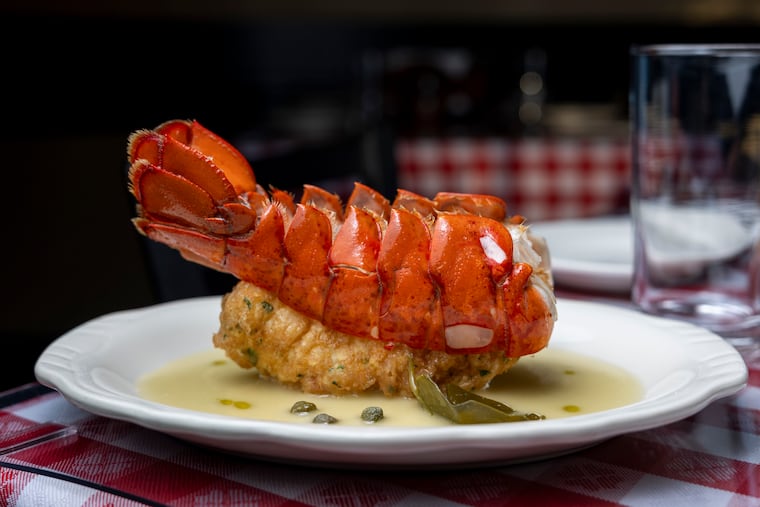
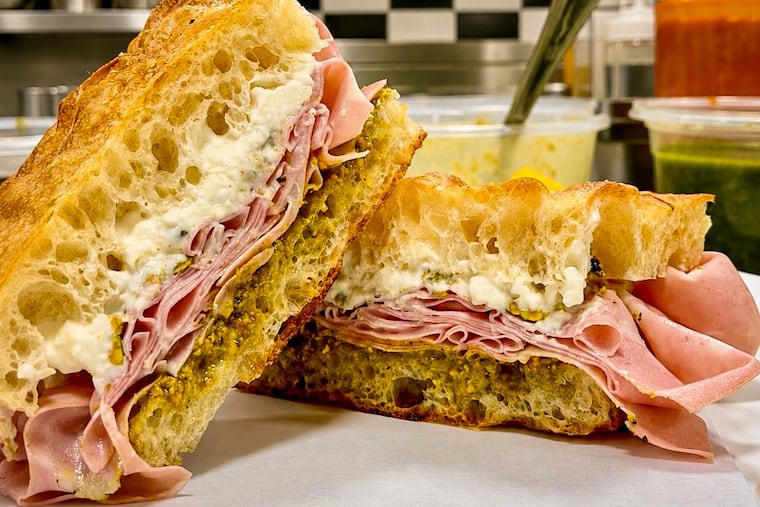
Go to Perla and grasp your lechon like Odysseus did when he landed on Ithaca’s shores and went to the cottage of Eumaeus, the swineherd, before he continued on home. Seek after North by Texas, the roving barbecue pop-up, just as Odysseus’ men held out until they could no longer and barbecued one of Apollo’s herd. Order a porchetta from Esposito’s or Porco’s Porchetteria and have all your friends over. Look for Le Virtù’s whole roasted goat, inhale the remnants of smoke, dig in with your hands. Grab yourself a cheesecake, imagine it to be Circe’s “kukion,” drizzle it with honey, and wash it down with wine.
When I go to restaurants as part of my job, I always, at the end of each meal, ask my dining companions two questions that cut straight to the point: Would you come back? And would you recommend it to others?
The answers to these are generally the same, both yes or both no. To hold Nolan’s Odyssey to the same parameters as a meal, I would not watch it again, but I would recommend it to others.
Just please, go get a nice dinner afterward.
Inquirer Food Festival
Get your ticket to Philly’s ultimate food party! Join top Philly chefs and bakers for one unforgettable day of food.