Wildfire smoke and a Delco junkyard fire raise concerns about Philly air quality amid high temps
Today’s high temperatures and humidity will be met by smoke drifting south from a batch of Canadian wildfires.
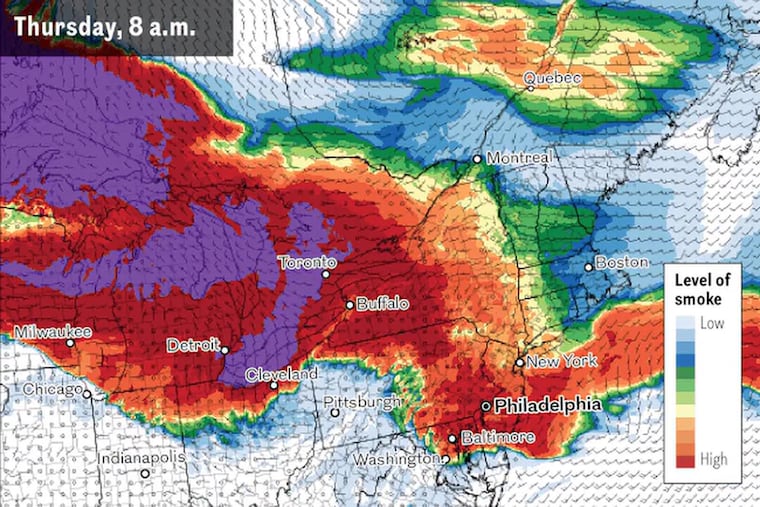
An unpleasant meteorological melange of heat and pollutants is about to envelop the region.
Continuing high temperatures and high humidity will be met by smoke drifting south from a batch of Canadian wildfires.
The smoke will bring hazy skies and fine particle pollutants that can irritate lungs and increase health threats to those with asthma and respiratory illnesses.
Additionally, smoke from a large scrapyard fire at EMR’s facility in Darby Township, Delaware County, on Wednesday prompted the Philadelphia Department of Public Health to urge residents to take precautions to avoid exposure. The fire was brought under control by 4 p.m., but smoke was still visible.
The heat
The National Weather Service has issued an extreme heat warning for Wednesday with heat index values expected up to 107. Thursday’s forecast calls for areas of smoke and mostly sunny, with a high near 96.
The conditions could worsen ground-level ozone, a pollutant that forms when nitrogen oxides and volatile organics emitted by vehicles, power plants, and industry react in sunlight, especially during hot days.
Ozone can cause airways to constrict, leading to shortness of breath, and so it can especially affect those with asthma, emphysema, and chronic bronchitis.
The smoke
And then there is the smoke that carries PM2.5, a fine particulate matter measuring 2.5 microns or smaller. It is of special concern because the particles are so small — far smaller than the width of a human hair — that they are easily inhalable.
Health effects can stem from short or long exposure, and can range from aggravation of asthma and other respiratory illnesses to premature death in people with chronic heart or lung diseases. Children and seniors are most vulnerable.
Philadelphia’s Air Management Services is monitoring for wildfire smoke but has not issued any statements.
The city launched a real-time network of air quality monitors last year that measure PM2.5 and nitrogen dioxide (NO2), a component of ozone.
The air quality in Philadelphia at noon Wednesday was listed as moderate, meaning there may be a risk for people unusually sensitive to air pollution.
The Pennsylvania Department of Environmental Protection has declared a statewide Code Red air quality day for PM2.5 for Thursday due to the wildfire smoke.
Code Red means that young children, elderly people, and those with respiratory problems, such as asthma, emphysema, and bronchitis, are especially vulnerable and should avoid outdoor activities. Everyone else should reduce prolonged or heavy exertion.
When we’ll see smoke
Paul Fitzsimmons, a meteorologist with the National Weather Service in Mount Holly, said smoke from the Canadian wildfires was expected to enter northeast Pennsylvania and northwest New Jersey on Wednesday afternoon. It would then carry into Philly.
“It’s possible for visibility getting into the range of one or two miles,” Fitzsimmons said. Typically, visibility is about six miles under clear conditions.
The weather service said the smoke will be closer to the ground and especially acute on Thursday.
“This is the kind that you’ll be able to smell outside, reducing visibility and potentially causing air quality issues,” the forecasting agency said on social media.
Smoke from Canadian wildfires has become almost an annual summer ritual.
Last June, Canadian wildfire smoke brought a milky haze to Philly, prompting an air quality alert. In August 2024, the smoke produced a haze higher in the sky.
And in June 2023, smoke affected conditions at a Phillies game. Visibility was at two miles.
A public health threat
Jane Clougherty, a professor of environmental health at Drexel University’s Dornsife School of Public Health, was in Toronto on Wednesday and said she could see a yellow haze.
“From a scientific standpoint, this increase in the frequency and severity of wildfire smoke absolutely is related to climate change,” Clougherty said.
The combination of increasing heat and wildfires exacerbated by climate change, she said, is a public health threat.
Wildfire season is starting earlier and lasting longer, she noted. Scientists are still studying the impact of wildfire smoke beyond just fine particulate matter.
But Clougherty was also concerned about the scrapyard fire.
The Philadelphia Office of Emergency Management said it had not detected hazardous substances, and a 4 p.m. email by the office said it would no longer be updating residents. However, it was still recommending that people avoid exposure to the smoke, and avoid going outdoors if possible, close windows and doors, and use fans to recirculate air.
She said varied materials were burning and could emit volatile organic compounds (VOCs), polycyclic aromatic hydrocarbons (PAHs), and potentially old lead.
She said those gases can heighten the human body’s adverse reaction to fine particles.
She believes that nearby residents should leave if possible, despite the shelter-in-place warning and advice to circulate air with fans. She noted that fans do not filter hazardous particles.
If they cannot leave, she said, she suggests residents use HEPA filters in their air-conditioning or use N95 masks.