Pennsylvania wasn’t just the birthplace of democracy, it was a key inspiration
A trio of foundation leaders asks us to reflect on our political heritage of tolerance, as established by William Penn, and as illuminated by a new exhibit at the National Constitution Center.
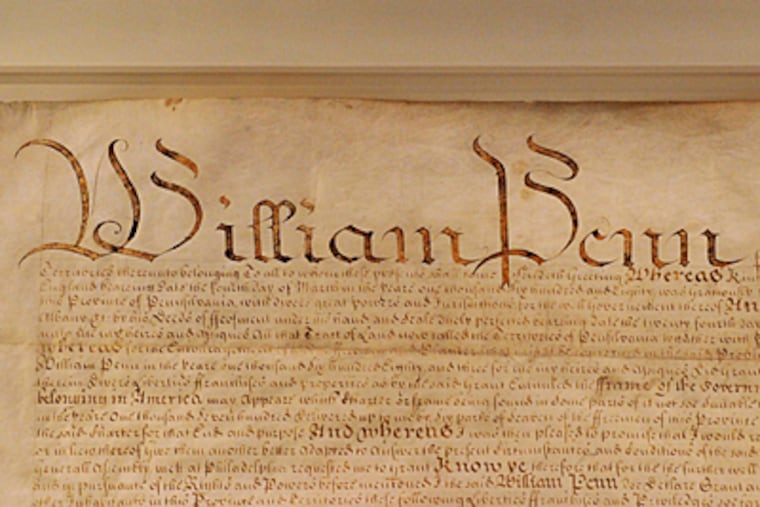
It’s been an extraordinary summer celebrating America’s 250th, but before we shift our focus from the events of 1776, we would direct the minds of our fellow Pennsylvanians to an earlier period — to the founding of the commonwealth and to William Penn’s forward-thinking advocacy for religious and political freedom and his belief in democratic self-government. These ideas were central to his political philosophy and plans for the early government of Pennsylvania. They also found their way into the democratic experiment we steward today.
Although Philadelphia played an important role in setting the stage for a stunning world event — the birth of American democracy — the city was more than just a geographically convenient location for the nation’s founders to gather.
By the time of the Revolution, Pennsylvania had become an important intellectual and economic center of the colonies, and the unique political culture and form of government established at its founding helped inform and inspire the development of American democracy, later embodied in the U.S. Constitution and Bill of Rights.
As Pennsylvanians, we are the inheritors of this impressive and innovative political heritage, a legacy that should be an important point of civic pride and inspiration for local patriotism.
Think about this: a decade after Penn arrived in America and began the work of establishing a refuge for religious dissenters, colonial Massachusetts accused nearly 200 individuals of witchcraft and executed 19 people. Massachusetts had a state religion until 1833; Pennsylvania never had a state religion.
After the end of the short-lived Maryland Toleration Act, Pennsylvania became the only colony where the Catholic church enjoyed ongoing, legally secure protection.
And, of course, Pennsylvania is also home to the “Synagogue of the American Revolution,” Congregation Mikveh Israel, one of the oldest synagogues in the nation dating to 1740.
As historian Nicolas P. Miller observed, the success of colonial Pennsylvania was linked in the minds of many onlookers to the freedoms, particularly religious liberty, that its inhabitants enjoyed.
To remind Pennsylvanians of our special birthright of religious tolerance, farsighted political liberties, and a long tradition of self-government that pre-date the nation, Poor Richards Charitable Trust, the William Penn Foundation, the Connelly Foundation, and the Syde Hurdus Foundation —in partnership with Drexel University’s Lenfest Center for Cultural Partnerships and the National Constitution Center — are presenting a new exhibit: “Pennsylvania’s Founding: How a City and a Colony Shaped America’s Civic DNA.”
For the first time, this exhibit will bring together original versions of several of the most important artifacts that helped define the civic and political character of early Pennsylvania and tell the story of how the founding of the commonwealth helped inspire American democracy.
They include the 1681 Pennsylvania Charter, signed by King Charles II, establishing the colony and granting Penn authority to govern; Penn’s 1701 Charter of Privileges, a framework of government for Pennsylvania until 1776, establishing religious freedom and other liberties and protections; a Lenape wampum belt given to William Penn, associated with the 1682 Treaty of Shackamaxon, symbolizing a hoped-for moment of peace and cooperation; the 1696 Quaker Protest Against Slavery, one of the earliest in the Americas, and materials connected to early abolitionist Benjamin Lay; and other artifacts that clearly document Penn’s and Pennsylvania’s key contributions to the establishment of American democracy.
The exhibit will be on view to the public, free of charge, at the National Constitution Center from Sept. 30 through Jan. 3, 2027. Learn more here.
So, this fall, let’s continue the semiquincentennial celebration. We encourage all Pennsylvanians to make a special pilgrimage to the National Constitution Center to see, understand, and remember our political heritage that is ours, alone – a world-changing and invaluable inheritance of tolerance that we should continue to aspire to today.
Tom Riley is the president of the Connelly Foundation. David Seltzer is a trustee of Poor Richards Charitable Trust. Shawn McCaney is the executive director of the William Penn Foundation.