Philadelphia should use the Waymo testing period to get this right, not rush it
The pattern that is emerging is that problems that should have been caught during testing are instead being confronted when the autonomous vehicles have already been deployed.
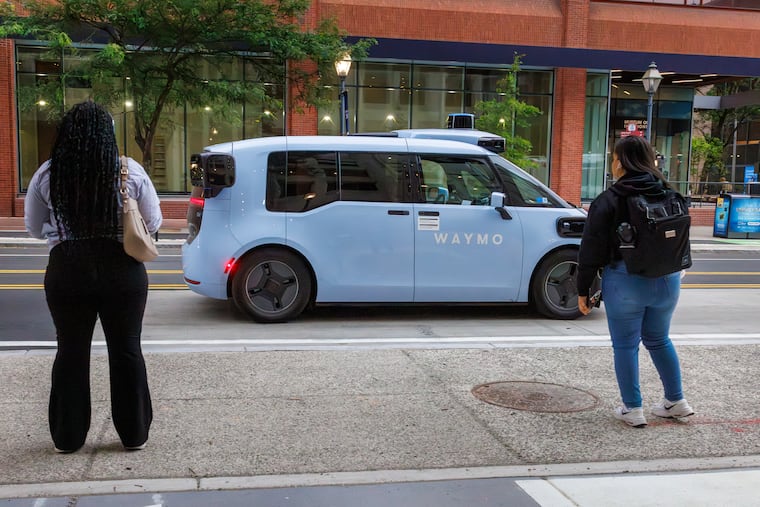
Waymo’s driverless cars have been rolling through Center City for almost a year now. Still with a trained specialist behind the wheel, still without a commercial launch date.
Some of our local elected officials have expressed concerns about driverless vehicles on Philadelphia streets. Based on what has happened in other cities, their concerns are not unfounded. When it comes to deploying robotaxis, Philadelphia should slow down, not speed up.
The pattern that has emerged across the country is that problems that should have been caught during testing are instead being confronted when the autonomous vehicles have already been deployed and are carrying passengers.
Start with what happened in Austin, Texas, this spring. When a gunman opened fire outside a bar on Sixth Street, killing three people and wounding more than a dozen, several Waymo vehicles ended up blocking the emergency response. One sat sideways in the road as an ambulance tried to get through, with bystanders shouting at it to move, while a police officer worked the car’s speaker system trying to get a human being on the line.
In San Francisco, fire crews and other first responders have had to physically take control of stalled Waymos to move them out of the way during emergencies. These aren’t isolated glitches.
Federal regulators counted at least six incidents nationally in which first responders had to take control of a Waymo vehicle during an emergency. In July, the National Highway Traffic Safety Administration told the industry that emergency scenes are not rare or extreme “edge cases,” and that an automated vehicle unable to interact safely with first responders is a danger to the public.
That’s the backdrop against which Philadelphia is being asked to move forward.
Councilmember Nina Ahmad gave voice to concerns after a City Council hearing in May. “Progress for the sake of progress isn’t enough. We need to look at the impact of that progress,” she said during a news conference. She wasn’t the only Council member who expressed reservations, or whose questions for Waymo went unanswered at the hearing.
Under state law, PennDot holds the authority to certify these vehicles for full commercial service. City officials have said Philadelphia is preempted from regulating this technology at all.
After Waymo vehicles became immobilized and helped bring San Francisco traffic to a standstill during the city’s July Fourth celebration, Mayor Daniel Lurie called for stronger statewide standards that verify that the autonomous vehicles’ systems can handle major events and emergencies before they are allowed to operate. His message was simple: “Prove it before you deploy it.”
Here is the question I’d ask before this moves one step further in Philadelphia: Have the police officers, firefighters, and paramedics who will be on the street been trained, specifically and verifiably, to handle a car that will not pull over for a siren, will not respond to a hand signal or a flare, and has no driver to negotiate with?
A first responder trained to deal with a human behind the wheel is not automatically equipped to deal with an empty vehicle that only takes instructions from a call center hundreds or thousands of miles away. Austin’s ambulance crews and San Francisco’s fire companies found out about that gap in real time, during emergencies — Philadelphia doesn’t have to.
Cities where Waymo has already launched are the ones now writing the incident reports.
The company cites a substantial reduction in serious-injury collisions compared with human drivers, and that’s worth weighing. But a strong overall safety record and a specific, unresolved gap around emergency scenes are not the same question, and cities where Waymo has already launched are the ones now writing the incident reports.
Philadelphia has something Austin and San Francisco didn’t have when they signed up for driverless service at scale: time.
This is the moment to apply Mayor Lurie’s standard: Prove it before you deploy it.
Amy Witherite is a traffic safety advocate and founder of the Witherite Law Group, which has offices in Philadelphia.