Letters to the Editor | Aug. 3, 2026
Inquirer readers on the Iran war and the future of the William Way LGBT Community Center.
Future focused
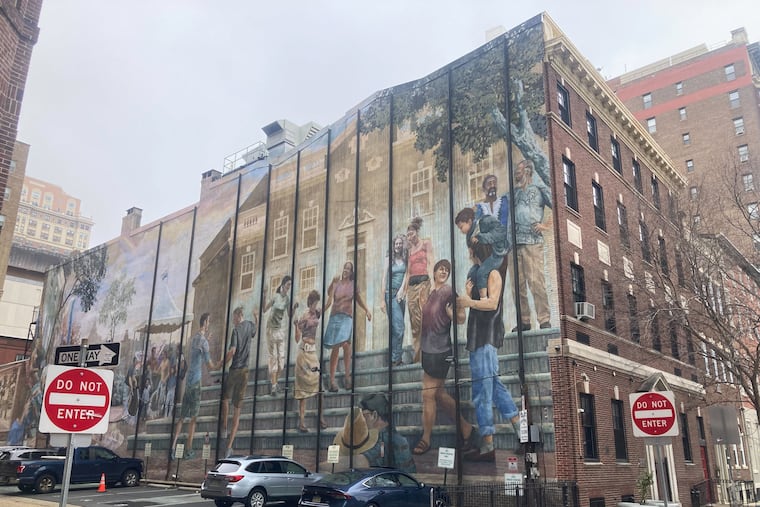
Inga Saffron’s recent column about the William Way LGBT Community Center overlooked the mission guiding our plans for the future.
Our responsibility is to create an accessible home equipped to serve our community while allowing William Way to remain in the Gayborhood. Throughout this process, we continue to provide essential programs, arts and cultural initiatives, community connections, and support.
The article dismissed the extensive planning that informed this direction. Our board voted unanimously after more than a year of evaluating options, engaging stakeholders, and studying the financial realities of preserving the existing building.
At a time when LGBTQ+ people and institutions face renewed threats, our community needs safe and welcoming places to find support, connection, and belonging. As plans for 1315 Spruce St. continue to evolve, William Way remains focused on creating an accessible and lasting home that will be here for our community now and for generations to come.
Laura Ryan and Dave Huting, co-board chairs, William Way LGBT Community Center Board of Directors
...
Inga Saffron’s column reminds us that tearing down the William Way LGBT Community Center’s longtime home would mean losing much more than a building. Since relocating to 1315 Spruce St. in 1996, William Way has become one of Philadelphia’s key LGBTQ+ landmarks, where generations have found support, services, culture, history, and community.
There is no disagreement on the need for more services, better accessibility, or affordable housing for LGBTQ+ seniors. These are important goals, even if housing has not historically been part of the center’s mission. However, the public has yet to see why those goals require demolition, or if preservation and reuse options have been thoroughly considered.
This should not be viewed as a choice between affordable housing and LGBTQ+ history. Philadelphia has shown that historic buildings can be updated for modern needs. William Way deserves the same consideration, and a creative preservation approach could preserve the best of the existing structure while allowing a modern addition.
The Preservation Alliance is urging William Way’s board to pause irreversible actions, publicly review reuse options, and organize meaningful community meetings before making final decisions. The future of William Way should involve the community, not just be handed down to it.
Paul Steinke, executive director, Preservation Alliance for Greater Philadelphia, and former, William Way Board co-chair (2016—2020)
Who knew?
I read your editorial about John Fetterman’s threat to quit the Democratic Party with incredulity. Just how were Southeast Pennsylvania voters to know anything about Candidate Fetterman when The Inquirer seemed reluctant to ask him any substantive questions during his campaign? Your coverage of his Senate race that year was highly dependent on quotes from his staff and postings on Twitter. The most we learned was that he was pro-union, advocated for the decriminalization of marijuana, and supported abortion rights. Beyond that, nada.
Even toward the end of his campaign, after meeting with the Inquirer’s Editorial Board, the paper stated “However, Fetterman was often vague in describing specific policies or the role he hoped to carve out in the Senate as he spoke for nearly 30 minutes with The Inquirer’s Editorial Board and two reporters.”
Don’t pretend voters knew John Fetterman when The Inquirer could have done a much better job of letting us know who he was.
Paul Withington, West Chester
Protesting protesters
Citizens Bank, in its news release announcing its winding down of lending to private prison firms CoreCivic and The Geo Group, notes that this is “a business decision based on changed commercial circumstances.” Yet, it goes on in the release to extensively castigate activists who protested its lending practice, saying “Citizens has been disappointed that the activists have dragged it into what is largely a political matter.” If, in fact, theirs was purely a business decision, then why does Citizens feel the need to lash out against those who protested this lending practice in support of our immigrant neighbors? Methinks the bank doth protest too much.
Louis Pilla, King of Prussia
Altered reality
In 2019, Donald Trump used a black Sharpie to change the path of a hurricane to match his earlier tweet. Now he has taken a metaphorical Sharpie to American soldiers who died in the Iran war. He changed the number of dead from 18 to 14, claiming the last four died after a ceasefire was declared. Next he will be sending FBI agents armed with black Sharpies to gas stations around the country, slashing the price of regular gas from $4.09 a gallon to $3.09 a gallon. At long last he will make good on his campaign promise to solve the affordability crisis.
Gary Goldman, Newtown
Contrasting legacies
On Tuesday, President Donald Trump eulogized Sen. Lindsey Graham at the National Cathedral, stating that Graham “was truly hawkish. He never saw a war that he didn’t like.”
At roughly the same time, I was attending a Memorial Mass for the Feast of Blessed Stanley Rother, an Oklahoma-born priest and martyr, at the Basilica of the National Shrine of the Immaculate Conception, also in Washington — where I heard a very different message.
On July 28, 1981, a brutal right-wing Guatemalan government death squad assassinated Father Rother in the church where he pastored Indigenous people attempting to improve the quality of their impoverished lives.
Rother’s message remains that our lives be like his life of human sacrifice and inspiration always in the pursuit of peace and understanding.
Reggie Regrut, Phillipsburg
History’s lessons
Your editorial on how President Donald Trump can find a way out of his failed Iran war raises several good points, the most significant one being that Trump’s obvious failure to support the NATO alliance and our European allies has destroyed the possibility of multinational diplomacy. You also argue rightly that simply withdrawing from the Obama-era international agreement that convinced Iran to avoid building nuclear weapons was a mistake. I would add that the killing of Iran’s top leader, the Ayatollah Ali Khamenei, only angered and even emboldened the country.
Unfortunately, you neglect one all-important fact about the prior nuclear agreement — it did nothing to curtail Iran’s proxy forces that menace its neighbors, including our ally Israel. This threat alone justifies pressure on Iran beyond that which produced the prior agreement. You also ignore past history, which rhymes with what is happening now.
In 1979, Iran had our hostages. Today, they hold the Strait of Hormuz and the world’s oil supply. While Jimmy Carter got Iran close to releasing the hostages, what brought that episode to a close was the election of Ronald Reagan and the Iranians’ realization that he was likely to treat them aggressively rather than stopping at diplomacy. Further, it looks as if Iran is simply stalling against our unilateral negotiations at this time. It’s hardly a sure thing that multinational negotiations would do much better.
Some experts have opined that having our military forcibly open and patrol the strait is the only leverage we have in the present situation. The only way out of this nightmare may very well prove to be escalation rather than continuing the present failed course, and past history suggests strongly that this is so — a probability that The Inquirer’s Editorial Board needs to consider.
John Baxter, Toano, Va.
Join the conversation: Send letters to letters@inquirer.com. Limit length to 150 words and include home address and day and evening phone number. Letters run in The Inquirer six days a week on the editorial pages and online.