Galleries: Zipping, morphing, digitally animated scans of drawings
If you've seen Sharon Louden's paintings and drawings, you've noticed how her transparent, pudgy, colored lines look as if they're zipping and morphing across their all-white backgrounds like so many kids set loose on a playground, shifting from a simple stroke to a rectangle, or from a Z to an L to a chain-link of shapes.
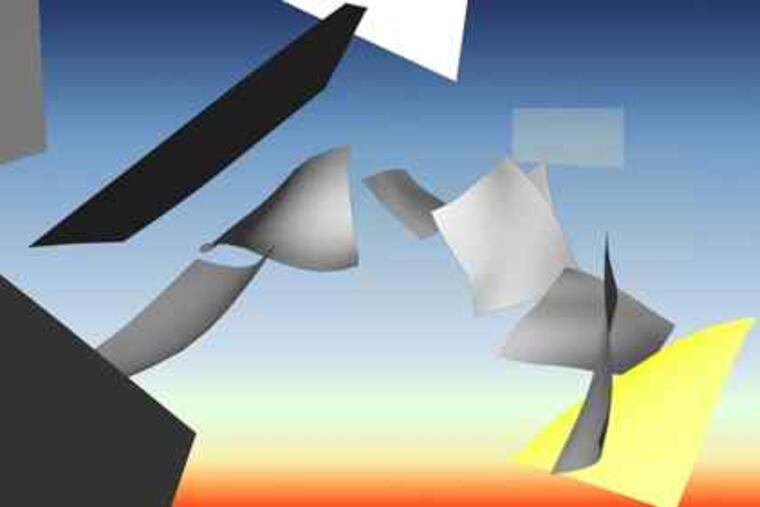
If you've seen Sharon Louden's paintings and drawings, you've noticed how her transparent, pudgy, colored lines look as if they're zipping and morphing across their all-white backgrounds like so many kids set loose on a playground, shifting from a simple stroke to a rectangle, or from a Z to an L to a chain-link of shapes.
Clearly, Louden noticed that effect, too; over the last three years, she has been digitally animating scans of her drawings, the videos of which are being shown in Gallery Joe's vault space. Now, her lines are, in fact, drawings in motion: swooping up into the air, falling like feathers, and landing kerplunk in piles like pickup sticks.
Each of Louden's eight short DVDs enacts an abstract narrative that hews so perfectly to its title, you wonder at times if the title came first and set the stage for the procession of images that follows (not hard to imagine, since the word that forms the title morphs into the rest of the video). In Hugs, her lines suggest an affection for each other; in Heavy, the lines' movement is slow and restrained.
The Bridge, the most ambitious of the group, is also being shown in Louden's traveling exhibition, "Sharon Louden: Taking Turns," organized by the Birmingham Museum of Art and now at the Weatherspoon Art Museum in Greensboro, N.C. It begins with an image of an elemental landscape that gradually becomes a stage for all of Louden's lines in all their variety. Those marks transform into a kind of floating confetti, and then into rectangles that suggest windows into space. Eventually the original landscape returns, like Dorothy to Kansas. Though Louden's drawings for The Bridge are here for viewing, arranged in neat piles on a pedestal, you assume that only she could navigate her leap from paper to the third and fourth dimensions.
Nicole Phungrasamee Fein, who is showing her latest watercolor drawings in the front of the gallery, has made some changes since her first show here in 2006. Her former palette, a virtual color chart of hues, has given way to soft grays and tans, and she's painting with a larger brush than before, which gives her small works on paper a physicality they previously lacked (several of these watercolors could even pass for studies of closed window blinds).
In their new, muted colors, Phungrasamee Fein's refined compositions of grids and horizontal lines offer an unusual combination of the otherworldly and a resolute plainness that brings to mind both Jasper Johns and Agnes Martin.
Out, out!
Exhibitions of outdoor sculpture have never been the Woodmere Art Museum's strongest suit, but "Intention: Nine Philadelphia Sculptors," curated by Paul Hubbard, a sculptor and professor at Moore College of Art & Design, is a major improvement on its predecessors.
It has attitude, for one thing. Warren Angle's Wallow, three black-painted pigs (one toppled over and looking distinctly dead) in a pool of tarry, dried black paint, and Martha Gelarden's Duchamp Reclamation Project - a "windmill" of snow shovels accompanied by suitcases - are smart, subversive, and a breath of fresh air for the Chestnut Hill museum. Jeanne Jaffe, whose Field of Forms - five organically shaped bronze forms atop metal rods, seemingly a humorous nod to Brancusi and Arp - was another inspired choice.
Hubbard's own wizardly geometric "tabletop" sculpture (it sits on enormous wooden table legs) Instrument for Discovery has a like-minded friend in Robert Roesch's arrangement of geometric shapes, Kill Buddha. And both share the quirkiness of Scot Kaylor's Feint, a rope circle within a metal circle that is strung on cables between two trees. Talk about fearful symmetry.
Contributions from Warren Holzman, Barry Parker, and Joe Mooney, all of a more modernist or classical bent, round out this show.
If you've come to the Woodmere, you should continue on to the Morris Arboretum, a few blocks west, to see Patrick Dougherty's remarkable site-specific outdoor sculpture Summer Palace, constructed from branches and vines and in place until it deteriorates. It's not only an astoundingly enormous and beautiful work that you can walk into - like a wild and organic Richard Serra - but it possesses one of the loveliest natural sites you'll ever see.
5 p.m. Tuesday-Saturday, 1 to
5 p.m. Sundays. 215-247-0476 or www.woodmereartmuseum.org. Through August 2.
Morris Arboretum of the University of Pennsylvania,
100 E. Northwestern Ave.,
10 a.m. to 4 p.m. weekdays,
10 a.m. to 5 p.m. Saturdays
and Sundays. 215-247-5777 or www.morrisarboretum.org.