National Gallery studied whether Freedom 250 IndyCar vibrations will affect art
IndyCar racers will weave at speeds up to 185 mph among federal buildings, the National Gallery of Art, the National Archives, and the Smithsonian Institution’s Hirshhorn, Air and Space, and American Indian museums.
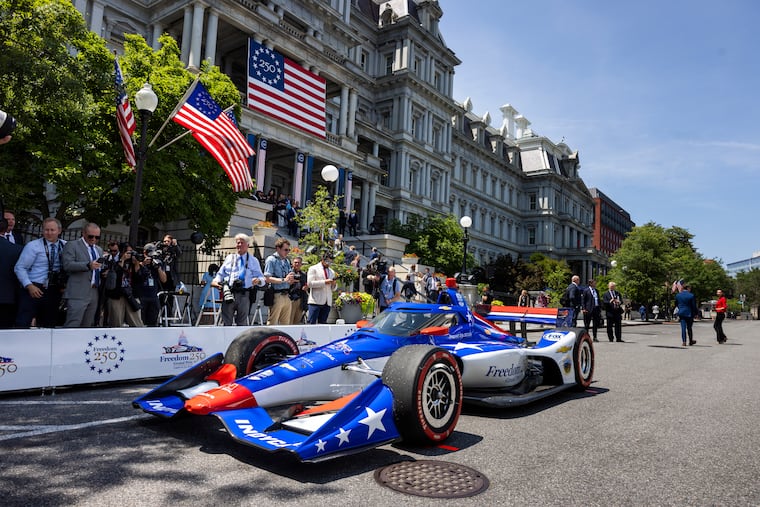
When the Freedom 250 Grand Prix kicks off this month as part of President Donald Trump’s summer celebrations, IndyCar racers will weave at speeds up to 185 mph among federal buildings, the National Gallery of Art, the National Archives, and the Smithsonian Institution’s Hirshhorn, Air and Space, and American Indian museums.
One of those institutions, the National Gallery of Art, has studied vibrations ahead of the race as it prepares for possible effects on its art — but it’s declining to say what it found.
“In preparation for the Freedom 250 Grand Prix, the National Gallery conducted an extensive vibration study and based on the results we have implemented a set of measures to ensure the safety of our staff, visitors, collection, and facilities during the race,” gallery spokesperson Chris Abanavas said in a statement. “While we are not releasing the specifics, I can share that any such measures are only being taken out of a great abundance of caution.”
The study didn’t raise concerns about structural risk to the buildings, Abanavas added. The race will also limit attendance at the free museum to ticket holders to the event’s secured area.
The Smithsonian determined the race, which will take place Aug. 22-23, will not threaten any objects in its collections and has taken no special precautions as a result, a Smithsonian official said. But the institution will monitor the situation before and during the race, so it can protect exhibits if that changes.
While the event is a first for D.C., it is not the first such race to pass through city streets and near museums, which commonly face vibrations from construction, musical events, and large crowds. But some historic preservationists worry the risk to delicate art pieces, historic documents, and priceless murals near the circuit has been underexamined.
In March, the National Park Service consulted with the D.C. State Historic Preservation Office about the IndyCar event, noting that it saw “no adverse effects.” The letter did not mention the museums along the route. (The National Park Service and the National Archives did not respond to a request for comment.)
Some preservationists who spoke with the Washington Post called the analysis insufficient and said a more comprehensive review of potential damage to historic properties or artifacts would have taken years, not months.
“I can’t think of any place in that whole area that goes where the speed limit is higher than 25 miles an hour,” said Michelle Arcari Rose, a former associate general counsel at the National Trust for Historic Preservation, which has sued to stop Trump’s White House ballroom project. “So whereas people think these grand prix races aren’t a problem, we certainly don’t know, right? It’s a huge risk to then unleash cars at 185 miles per hour in a place where we’ve never had cars really going more than 25 miles an hour.”
Mary Okin, assistant director of the nonprofit Living New Deal, sent a letter last week to the National Park Service and other agencies expressing concern that the event was permitted “without meaningful” consultation with “known preservation stakeholders.” The letter and the National Gallery of Art’s vibration study were first reported by the New Republic.
“Such vibrations are well above normal street traffic and even go beyond those of jackhammers, pile drivers, and even freight trains,” she wrote.
Okin is calling for safeguards including temporary sound barriers and damage assessments to help protect buildings such as the Wilbur J. Cohen Building, which sits on the circuit’s south edge and houses fragile New Deal-era murals.
“They’re vulnerable,” said Okin, whose organization has worked on the building’s preservation. “Excess vibrations and sound, as well as the construction of the racetrack itself, could very well cause damage.”
The General Services Administration, the body that manages real estate for the federal government, reviewed the proposed route for potential impacts on its assets and identified no areas of concern, a spokesperson said in a statement.
“The White House and [IndyCar owner] Penske have followed all appropriate protocols and been in close coordination with all relevant agencies to ensure this is also the safest and most secure race for all visitors to enjoy,” said Davis Ingle, a White House spokesperson.
While many major motorsport races are held on permanent road courses or oval tracks, temporary street circuits are a familiar part of international racing.
IndyCar stages several events on public roads in cities such as St. Petersburg, Fla.; Long Beach, Calif.; Detroit; and Toronto, while Formula One also races on street courses in places including Monaco, Singapore, and Las Vegas. The roads are closed, lined with concrete barriers, and transformed into racecourses for the events before reopening to traffic.
One of the closest comparisons with D.C.’s race is the Firestone Grand Prix of St. Petersburg, in which the street circuit runs next to the Dalí Museum. A museum spokesperson said the collection has remained safe and secure throughout the event’s history. The museum has not conducted race-specific vibration studies, but its galleries were built to museum standards and the collection is continuously monitored.
Green Savoree Racing Promotions, which organizes the St. Petersburg race, said the museum closes to visitors while racing is underway and reopens after the event concludes. The promoter also noted that the museum is housed in a hurricane-rated building constructed to Florida standards, allowing the artwork to remain in place during extreme weather, and said it was not aware of any additional precautions being necessary during the race.
In a statement, a Freedom 250 Grand Prix spokesperson said race organizers have “tremendous respect for the history and the structures surrounding the racing circuit in Washington, D.C.”
“IndyCar has successfully hosted races on downtown street circuits in urban areas for decades,” the spokesperson said. “With this excellent track record and the thorough preparation we have done for this event working closely with all the appropriate local and federal agencies, we do not anticipate any impact on the structures surrounding the circuit” as a result of the race.
Researchers have started paying closer attention to how vibrations from construction, live music, and major events may affect the art and artifacts inside museums.
One 2023 report studied the effects of vibrations from music and a NASCAR street race on museums in Chicago. In that case, racecars passed a south wall of the Art Institute of Chicago, near galleries holding a Van Gogh exhibition.
Advisers who reviewed data and consulted with NASCAR beforehand told the museum vibrations from the cars shouldn’t pose a major risk, according to the report. Afterward, they found museumgoers’ foot traffic caused greater vibrations in gallery floors than the race outside. (An author of the report declined to be interviewed, and the Art Institute says it works with specialists before any major activity that might cause vibrations.)
On Tuesday, there were few apparent changes at the National Gallery of Art except for enclosures set up around some artworks outside.
The I.M. Pei-designed triangular skylights, which abut a cascading sunken fountain and illuminate the underground cafe, have been boarded up. Between the West Building and the Sculpture Garden, a massive Alexander Calder sculpture made of sheet metal, Tom’s, has been enclosed in a protective barrier.
Some sculptures and installations were boarded up “out of an abundance of caution,” said Abanavas, citing “the increased visitor traffic around the National Mall this summer for events including the Grand Prix.”
As of publication, the Post did not identify significant changes to public collections inside the National Gallery of Art’s East Building, which closely faces the racetrack on Pennsylvania Avenue.