ICE begins outfitting Haitian immigrants with ankle monitors, attorneys say
The Department of Homeland Security starts what appears to be a new enforcement effort after the Supreme Court allowed the Trump administration to end their humanitarian protections.
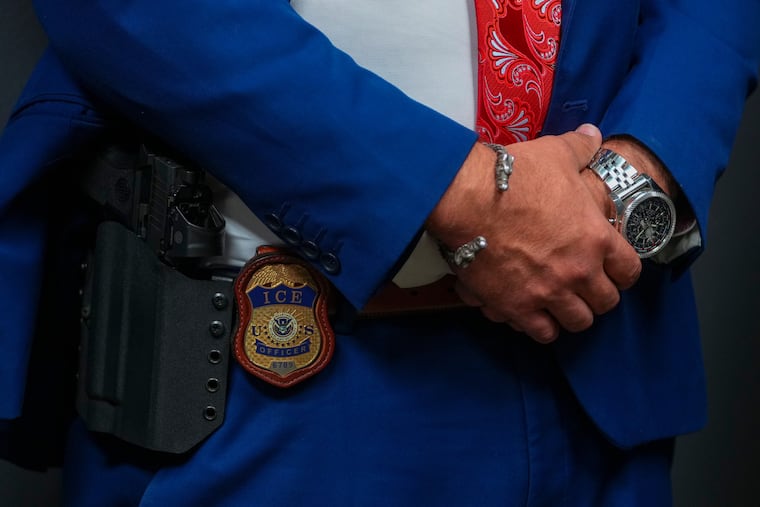
The Department of Homeland Security has begun summoning Haitian immigrants in Ohio to check-in appointments with federal officers who are outfitting them with ankle monitors, in what appears to be a new enforcement effort after the Supreme Court allowed the Trump administration to end their humanitarian protections.
Guerline Jozef, executive director of the Haitian Bridge Alliance, said about 50 Haitians with temporary protected status in Springfield, Ohio, were called into Immigration and Customs Enforcement offices on Friday. Local attorneys said the immigrants were arrested and then conditionally released with electronic monitoring devices. They were instructed not to travel anywhere outside a 75-mile radius from their homes.
A Trump administration official confirmed the effort to call Haitians with temporary protected status into ICE offices, give them ankle monitors, and release them. The official, who spoke on the condition of anonymity to discuss internal ICE operations, expected the check-ins to be scheduled in waves.
The U.S. Supreme Court ruled in June that the Trump administration could end temporary protections for about 350,000 Haitians, despite ongoing political instability and gang violence in the Caribbean nation. DHS alerted employers last week that it had officially ended temporary protected status for Haitians, triggering mass layoffs and confusion because a lower court that had blocked the administration’s attempts to terminate the program has not yet lifted the order keeping TPS benefits in effect.
Congress created temporary protected status in 1990 to shield immigrants in the United States from being deported to countries engulfed in armed conflict, a natural disaster, or another extraordinary crisis, allowing them to work legally in the U.S. for up to 18 months. Applicants to the program cannot have serious criminal records, and they must pay fees and pass a background check. DHS can renew the protections — and it has, multiple times, for several countries.
Advocates and immigration attorneys said the new arrests in Ohio reflect ICE’s attempts to more quietly carry out President Donald Trump’s deportation campaign. Rather than large-scale operations like the ones DHS conducted in Minneapolis and Chicago, the agency has been focusing on arrests that take place after traffic stops and ICE check-ins. Arrests rose significantly in July.
“Rather than showing up with a militarized force in a particular neighborhood in Springfield and having communities be able to organize around that, this is calling people into a very secure facility,” said Erik Crew, a senior attorney at the Haitian Bridge Alliance, a California-based advocacy organization. “Yes, people can protest outside, but sometimes people can go in and never come out and be sent to a detention center somewhere remote, likely in the South, and be sent out of the country from there.”
A DHS spokesperson said the agency does not discuss “ongoing or future” operations but conducts enforcement daily.
“Temporary Protected Status is exactly that — temporary. For too long, TPS has been allowed to function as a de facto amnesty program despite Congress never intending it to be permanent,” DHS said in a statement. “What we would say now is it’s closing time which means you don’t have to go home, but you can’t stay here.”
Many of the Haitians outfitted with ankle monitors in recent days have ongoing asylum claims and no final order of deportation, their attorneys said. Historically, the agency has deployed the worn devices on a case-by-case basis, but immigration attorney Carolyn Marks, who accompanied two Haitian clients to appointments with ICE on Sunday, said they are now being used more broadly.
“In the past, they have been used with people who have criminal records or had missed court hearings or an order of deportation,” Marks said. “But all these people had been and are complying with the law.”
Trump has long stated that he intended to target Haitian immigrants as part of his mass deportation drive. During his campaign, he falsely claimed that Haitian residents in Springfield were killing and eating their neighbors’ pets. After the Supreme Court ruling was announced, Stephen Miller, the White House deputy chief of staff, told reporters that Haitians and others with temporary protected status should be detained and deported once they lose the benefit.
Sens. Chris Murphy (D., Conn.) and Chris Van Hollen (D., Md.) criticized the Trump administration’s efforts to terminate TPS in a call with reporters on Monday. Both senators said the cancellations were not only putting families in danger but pulling thousands of needed workers out of the labor force.
“This is an embarrassment for the United States of America,” Murphy said. “There is no safe place to return for TPS holders from places like Haiti and Yemen and Venezuela and Syria. In fact, in those places I just mentioned, the situation is not stabilizing, getting better. It is getting worse.”
Katie Kersh, managing attorney with Advocates for Basic Legal Equality, a nonprofit based in Ohio that is providing legal representation to Haitian immigrants in the area, said ICE officers asked people who went to the check-ins over the weekend for biographical information and collected their fingerprints. She and other attorneys said the officers encouraged the immigrants to leave voluntarily and noted the $2,600 financial incentive DHS is offering those who choose to self-deport.
Kersh said one of her clients is a woman in her 60s who may miss the birth of her grandchild in Indiana as a result of the travel restrictions. She is a diabetic and worried that having the device strapped tightly to her ankle would cause pain. She inquired about an alternative, which ICE does sometimes provide, but was not offered one.
“ICE is setting up circumstances that makes it easier to detain them,” Kersh said.
Vilés Dorsainvil, who runs the Haitian Support Center in Springfield, stood outside an ICE office near Cincinnati as people reported for appointments. He said he asked ICE officers if the devices were necessary and was told that the “the order came from the top,” referring to DHS Secretary Markwayne Mullin.
DHS stated online last week that temporary protected status for Haitians was “terminated, effective July 27, 2026.” But lawyers say that TPS cannot officially end until lower courts execute a Supreme Court ruling and officially allow the Trump administration to terminate the program, which was first established for Haiti in response to the catastrophic 2010 earthquake in that country.
A DHS spokesperson disagreed, saying, “These activist lower court judges are openly defying the Supreme Court on this, but the end result will be the same. Haitians with TPS cannot and will not be able to stay.”
Jessica Bansal, an attorney focused on TPS litigation with the National Day Laborer Organizing Network, said that “for all practical intents and purposes, there is no longer any protection.”
Ruby Powers, a Houston immigration attorney who represented clients from Venezuela who lost TPS after the administration canceled it for those immigrants, said ankle monitors and more frequent ICE check-ins are a means of pressuring people to leave.
“It’s the government’s way of signaling, ‘We know where you are, we are monitoring you closely, and we have the ability to detain you at any time,’” she said.
Marks, the immigration attorney, said that whatever might happen next will change her community.
“It’s going to be a very destabilizing event for Springfield,” she said.