From 30th Street Station I walk east on Market - cross one river in pursuit of another. I watch the world beneath me shift. Asphalt. Curb cut. Bridge. A ribbon of discontinuous sidewalks.
Way down deep, the planet's inner iron core radiates some 5,000 Celsius degrees. Here, on the Market Street sidewalks, solidity is an illusion. The concrete panes are cracking. The bricks are buckling. The rising angles of the slate and granite tiles suggest the ceaseless motions of the Earth's crust and the convective power of a restless mantle.
A planetary urging from below.
A streetscape pounding from above.
The sidewalk like geology, I think.
There are policeman boots and a transvestite's naked feet on the walk as I walk. There are flip-flops, sandals, clogs, Florsheim slip-ons, tasseled loafers - the soles of the people hurrying on, taking something of the city with them, infinitesimal kernels of dust. There are discarded cups and a forgotten sandwich, an arterial system of cracks, the cradled butt of a cigarette, grates, a sudden landscape of granite, bubblegum that time has turned black.
There are markers of near and distant pasts.
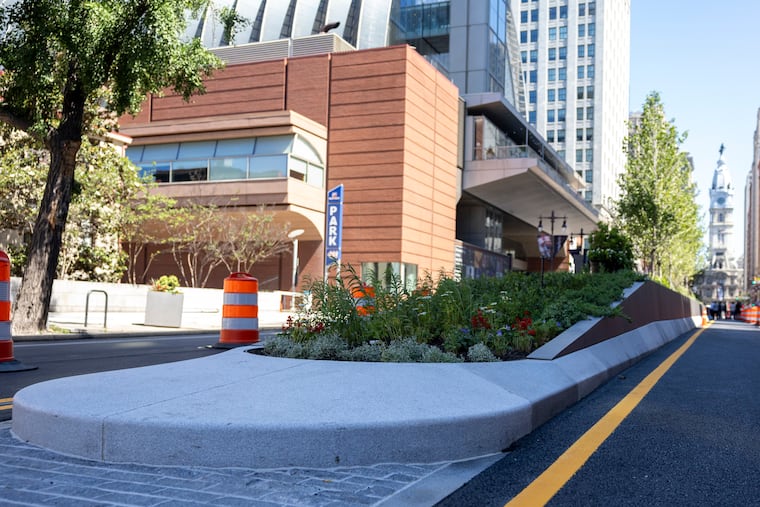
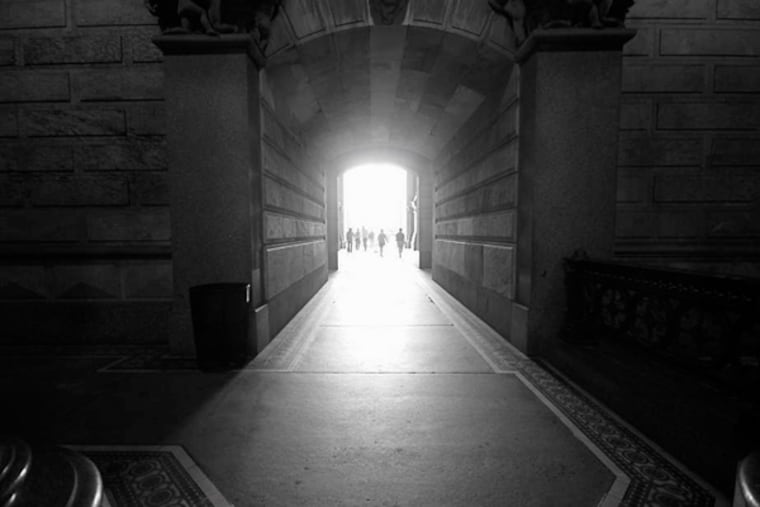
At 15th Street, the Dilworth Plaza construction barriers are still up, so I cut south for a quick walk around, then head back through City Hall's south portal to the courtyard, where the sterile brick and concrete plaza embodies a faded compass rose. Here, the rose says barely, you are. In the somber heart of things. In the echo chamber of decisions made, mayoral ponderings, debate. East is that way.
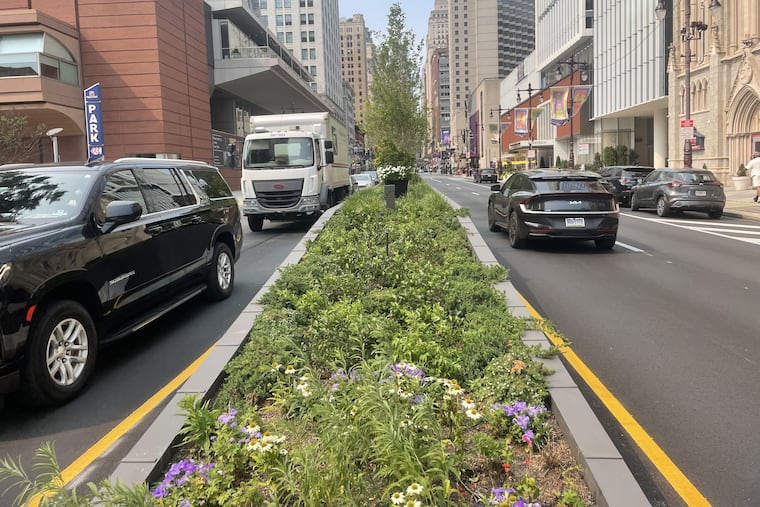
And I'm headed east. I'm back on the sidewalks proper, where commerce rules, the plastic tents of discount news, the purveyors of news, the subway entrances, the downward steps toward the Gallery, until the sidewalks change their tenor again, in deference to history. Keep your eyes down after Seventh Street, and you'll see it - the ruddy, banded brick, the slate geometries, the profusion of tourist shoes, and then this: the inscribed names and occupations of those who lived on Market between Sixth and Fifth during the year of the Constitutional Convention.
Joseph Redman, Gentleman.
John Cope, Grocer.
Amos Foulke, Merchant.
Adam Boush, Reedmaker.
Simon Stedicorn, Papermaker.
Their houses aren't here, but their names are. Traces of the past upon the scuffed and cracking sidewalk. Reminders of all the souls that once passed this way - the emanations of presidents and freedom builders, bankers and traders, children in their ruffled clothing, women on their way home from the open market, a cut of pork in hand, some root vegetables, perhaps a new pet bird - or a book.
Once was. Still somehow is. The sidewalk like history, I think.
At Third I take a detour and head north, where the sidewalks yield crated one-dollar records, free books in a plastic tub, fenced-in trees, grounded flowerboxes, a cigar Indian decked out with a fresh-red feather, a reading man in a borrowed chair, a leashed dog temporarily left behind. There is the spill of retail and sales, the promise of something vintage, street-facing mirrors that bring down the sky. Segways. A skateboard. A hand-walked bicycle. Someone who may be preparing to sing.
On the walk along Christ Church, Mala Wright stands by her "Once Upon a Nation" storytelling bench, preparing her true stories for passersby - tales of the actress/abolitionist Fanny Kemble and the slaveholder she inadvertently married, tales of a conscientious pastor who implored George Washington to stop the terrible bloodshed of the Revolutionary War. On an average day in the summer, about 60 to 90 people will gather on this sidewalk to wait and to listen, Mala says.
The sidewalk like a credence table, I think.
I have tarried too long. I am back on Market. I jump the final curb and follow the well-lamped curve of mostly red brick over I-95 and the Columbus Boulevard, toward Philadelphia's second river. Here, at the edge of things, the sidewalk goes no further; this pedestrian's work is done.
The sidewalk like the place a city ends.
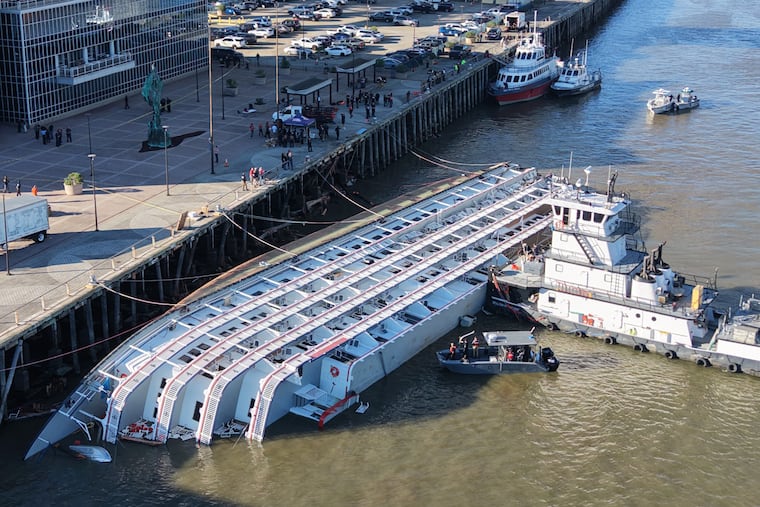
My eyes adjust to the flow of things, to the big ships, to the brown water, to the mirage of Camden. Close in, I notice a cluster of pilings, and there, on the pilings, the single duck that has built a nest out of pristine straw. She is watching me watch her. She is brooding over the future of an egg.
Our Earth is molten. Our city scuffs. There are emanating stories, one-dollar records, a fading compass rose, deep and just emerging cracks. There is new life in a river nest, just beyond our reach. The sidewalks tell the story.