Philly DA Larry Krasner faces legal and political uncertainty after a judge said he may have committed crimes
The fallout for Krasner is likely just beginning, and the legal and political ramifications could take months to play out.
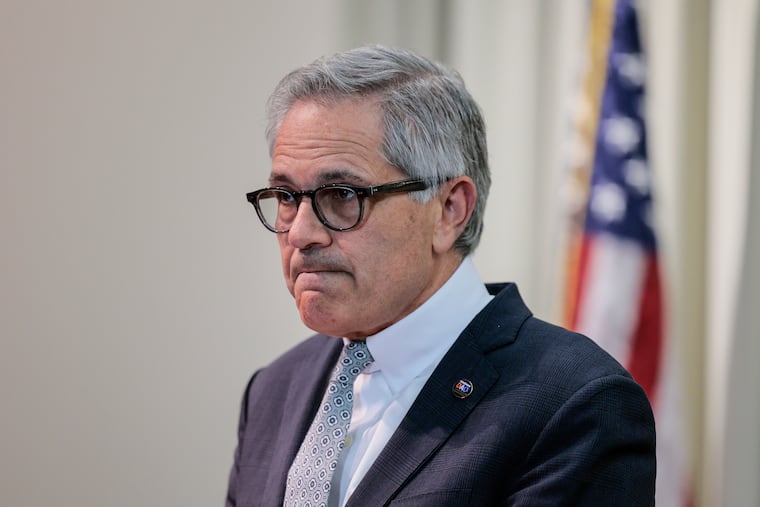
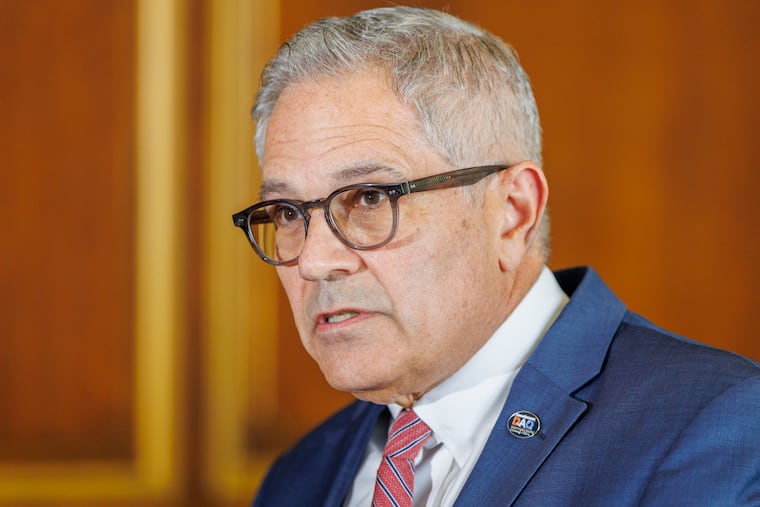
A federal judge’s statement this week that Philadelphia District Attorney Larry Krasner may have committed crimes while running his office came as part of a lengthy battle in a complex post-conviction case.
But the fallout is likely just beginning.
The stunning remarks by U.S. District Judge Paul S. Diamond — that Krasner may be guilty of conspiracy or obstruction of justice, and that federal prosecutors should investigate — triggered uncertainty over the future of one of the city’s top elected officials, who is a nationally recognized leader of the progressive prosecutor movement.
It amounts to the latest unprecedented episode of Krasner’s tumultuous tenure as the city’s DA — a stretch in which he’s also been impeached by the state house, excoriated by the Pennsylvania Supreme Court, and seen two of his highest-ranking deputies face disbarment and suspension in federal court.
Legal experts said Diamond’s decision to refer actions by Krasner and one of his supervisors to the U.S. Attorney’s Office would almost certainly lead to an inquiry of some kind. But the fate of any possible probe into Krasner was not only difficult to predict, they said, it could take months or longer to determine.
Political repercussions could arise as well.
While Krasner’s Republican enemies reiterated their long-held disdain for the reform-oriented prosecutor, no elected Democrats immediately came to his defense. And some Democrats in the city have quietly begun discussing potential contingency plans if Krasner is forced from office before the end of his third term in 2030.
Krasner, for his part, has denied wrongdoing, and said in a statement that he planned to appeal Diamond’s ruling, in which the judge also disqualified Krasner and a lawyer in his office, Matthew Stiegler, from participating in the underlying case — a matter in which a man is seeking to have his murder conviction overturned.
Here’s a recap of what led to Diamond’s scathing filing, and what might be next for Krasner.
What happened in the underlying case?
The case at issue began in 2015, when Dennis Johnson — found guilty in 2009 of second-degree murder — filed a petition in federal court seeking to have his conviction overturned.
For years, the district attorney’s office opposed Johnson’s bid for relief. But in 2022, then-Assistant District Attorney Jaclyn Mason filed a brief reversing course and agreeing that his trial counsel had been ineffective.
This spring, while preparing for a hearing before Diamond about the case, Mason said she reached out to new supervisors in the law division: Katherine Ernst, Steven Wildberger, David Napiorski, and Peter Andrews. And Ernst said when she reviewed Mason’s brief, she discovered it contained “significant errors,” and the supervisors decided they needed to try to withdraw it.
Mason thought they were setting her up to take the blame, so she quit. And in her resignation letter, she said Stiegler — her onetime boss — had forced her to file a faulty brief and that she wouldn’t lie or mislead the court to protect him.
After that, the supervisors testified, Stiegler proposed an unusual path forward, effectively suggesting they find a way to cast Mason as a “rogue” prosecutor prone to making mistakes.
Stiegler also shared his proposal with Krasner, the supervisors said, and the DA told them he thought it was a “really good idea.”
But the supervisors rejected it, they said. Wildberger told Diamond he found the notion “tremendously inappropriate.”
From internal disagreements to potential crimes
Krasner ultimately did agree to let the supervisors try to withdraw Mason’s brief. But he and the supervisors then got into heated arguments about whether to refer the case to state prosecutors — something the supervisors thought was appropriate because of the internal drama consuming their office.
As the referral debate raged on, the supervisors said, Krasner told them the case needed to stay in-house so someone could “protect the office” and “control the proceedings.” He also threatened “consequences” if any of them told Diamond about their discussions — which they took to mean being fired.
Diamond, in his memorandum, said threatening peoples’ jobs when they are trying to tell the truth to a judge could amount to obstruction of justice, as could attempting to conceal the truth about Stiegler’s role in the drafting of Mason’s brief.
He also said Krasner’s attempts to work with Stiegler to create a false narrative about Mason could amount to conspiracy.
And while the judge said he found the supervisors and Mason to have testified credibly, he said Stiegler may have committed perjury, calling his testimony “often contradictory, evasive, or outright dishonest.”
Will Krasner actually face charges?
For those reasons, Diamond said he had sent the case to the U.S. Attorney’s Office to investigate if Krasner or Stiegler should be charged.
Diamond, as a judge, does not have the power to prosecute the case himself. And how or if prosecutors decide to proceed remains an open question — and one that might remain unclear for some time.
Legal experts said it’s rare, though not unprecedented, for judges to refer potential wrongdoing to prosecutors. And any time that happens, they said, prosecutors take it seriously — reviewing any materials the judge disclosed, deliberating paths forward, and potentially empaneling a grand jury to begin calling witnesses.
Still, full criminal investigations often take months or years to conduct. And such probes — conducted in secret — can go in unexpected directions. Sometimes that might mean a broader discovery of wrongdoing than was initially expected. Other times, investigations can close without charges.
Also unclear is whether the local U.S. Attorney’s Office would oversee any potential investigation into Krasner — or if staffers from elsewhere in the Justice Department might be called on to handle it, since Philadelphia-based federal prosecutors often work on cases with lawyers in Krasner’s office.
A spokesperson for the U.S. Attorney’s Office declined to comment on Diamond’s memorandum.
Krasner has made no secret of his antipathy for President Donald Trump, and Trump, in his second term, has been unabashed about asking the Justice Department to prosecute political foes. It was not clear how or if that might influence prosecutors’ course of action in this case.
Whatever might happen, experts said, one thing was generally clear: A referral from a federal judge targeting an elected district attorney was practically unheard of.
“I really cannot think of an equivalent situation,” said Lauren Ouziel, a Temple University Law School professor and former federal prosecutor.
Michael Levy, who worked as a federal prosecutor in Philadelphia for nearly 40 years before retiring in 2019, said: “For a judge to do this, it’s really unusual.”
Could Krasner face other consequences?
Even if Krasner and Stiegler are not criminally charged, they could still face additional consequences.
If the case is referred to the federal court’s disciplinary committee, for example, a panel of judges could seek to determine whether any of the prosecutors involved behaved in a way that would warrant a suspension or disbarment from practicing in federal court.
That would likely be detrimental to Stiegler, who has spent much of his career working on federal cases. But it would be even more problematic for Krasner — and could raise questions about whether he could continue to serve as the city’s DA.
Still, similar to any criminal investigation, the disciplinary process — which is largely confidential — would also likely be lengthy. When some of Krasner’s deputies were disbarred or suspended in federal court in 2025, those outcomes came about three years after a federal judge said he was sending the case out for a disciplinary review.
Diamond did not specify if he was referring the matter to the region’s chief federal judge, the first step in a potential disciplinary inquiry. Legal experts said prosecutors — if they investigate — would likely prefer to have their probe take precedent over any potential disciplinary proceeding.
Will there be political fallout?
Outside of the legal realm, Krasner, a Democrat, has faced political attempts to oust him before.
In 2022, the Republican-led Pennsylvania House voted to impeach Krasner, saying he had not adequately enforced state laws and, by extension, had contributed to the city’s gun violence crisis.
Krasner denied the allegations, and appellate courts — including the Pennsylvania Supreme Court — later agreed with various arguments he made describing the process as improper.
Martina White, a Republican from Northeast Philadelphia who led the impeachment drive against Krasner, on Wednesday called for him to resign, saying in a statement that “Philadelphia needs a reliable DA, not a defendant-in-waiting.”
Few top Democrats defended Krasner.
Mayor Cherelle L. Parker declined to comment this week, as did City Council President Kenyatta Johnson, who supported Krasner’s bid for reelection last year.
Some activists on the progressive left said they still support Krasner and see Diamond’s referral as politically motivated. Diamond was appointed by former President George W. Bush, a Republican, in 2004.
“This is unfortunately a continuation of the right’s assault on DA Krasner and the policies that he’s implemented,” said Robert Saleem Holbrook, executive director of the progressive political group Straight Ahead. “This is a judge using an internal conflict in the office to further the objective of removing Krasner from office.”
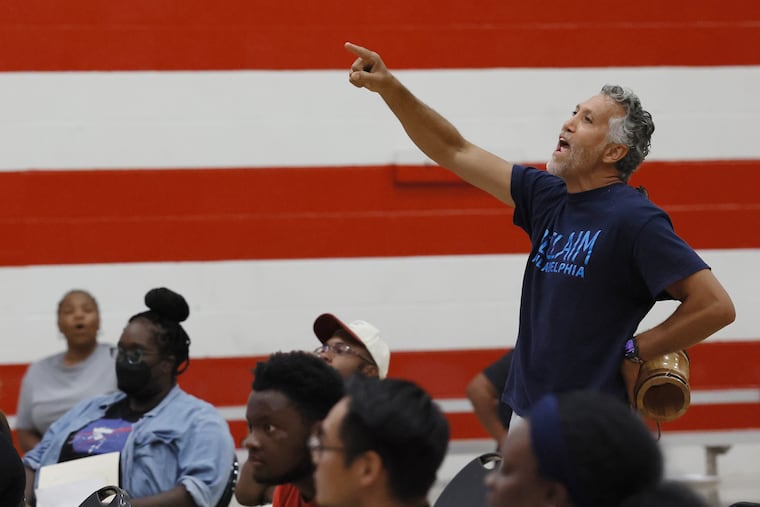
Krasner has proved politically resilient over the years, winning three terms despite the impeachment drive and opposition from elected officials in his own party, said Sergio Cea, political director of the progressive group Reclaim Philadelphia.
Krasner, he said, is “like Teflon.”
“He is somebody that has consistently, without the Democratic establishment support, won primary after primary,” he said. “And that is because he is wildly popular with Philly voters who are tired of status quo district attorneys who are more focused on filling jails than achieving justice.”
A ‘devastating’ environment
Krasner, meanwhile, is not in the office this week, according to people familiar with his whereabouts. First he was on a recruiting trip in Washington, D.C., they said, then he was headed on a pre-planned personal trip to Ireland.
Inside the office Wednesday, staffers said they were sharing feelings of dismay and fatigue from years of upheaval and political headlines under Krasner’s leadership. Multiple prosecutors, who spoke on the condition of anonymity to speak candidly about a sensitive matter, said they’ve endured the impeachment saga, mass firings, and the departure of veteran staffers.
And although some said Diamond’s ruling was not entirely surprising — the judge had signaled at a previous hearing that he might refer the matter to federal prosecutors — they also anticipated that any investigation could stretch on for months or even years,
One longtime prosecutor called the allegations “devastating” and said the reputation of the office “has been reduced to rubble.”