Eagles’ silence on their role in the Macklemore mess has become deafening
What’s worse about the Macklemore-Ed Sheeran debacle in Philly? The Eagles’ role, or the team’s refusal to explain it?
Ed Sheeran walked onto a big stage at Lincoln Financial Field Saturday night with nothing but his guitar to support him. Surrounded by tens of thousands of fans, a massive global pop star may have never felt so all alone.
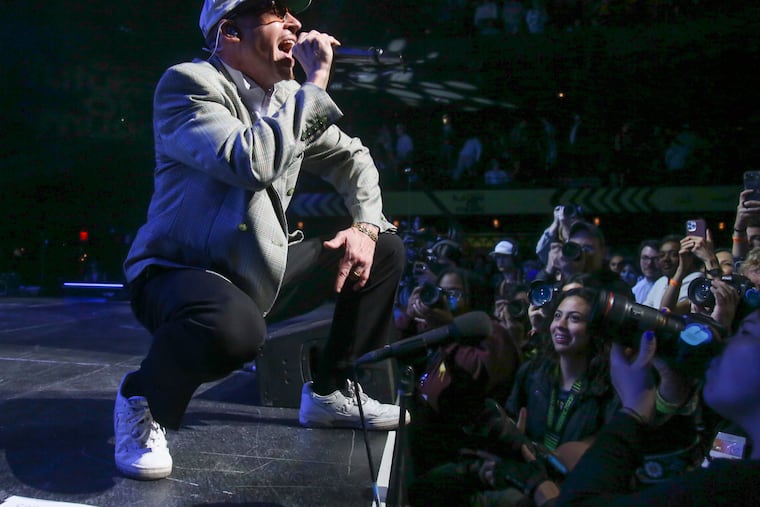
Sheeran knew he couldn’t hit his first note without addressing everything that had happened in the last few days: the dropping of hip-hop’s Macklemore from his U.S. football-stadium tour after onstage comments supporting a free Palestine riled one team owner, and the massive backlash that had turned a pop festival into a solo gig.
That’s how an artist who’s sold more than 200 million records and became one of Time’s 100 most influential people in the world by mostly avoiding politics could no longer avoid politics. He condemned both the Oct. 7, 2023 attack on Israel by Hamas but also Israel’s deadly three-year response in Gaza, which he called “catastrophic and unjustifiable and disproportionate” — essentially the same sentiment that got Macklemore cancelled.
That will be the headline in most news articles, but as I watched the viral video Saturday night I was wondering if Sheeran would tackle the other elephant in the room. He did.
“I am deeply worried about the idea that venues should pre-approve content for performers,” Sheeran proclaimed in his native Yorkshire accent. “This happens in so many places around the world, but it should never happen in the free world.”
The performer’s words drew a big whoop from the assembled multitude who showed up despite a week of controversy that had seen Sheeran’s backing band and all of his opening acts quit in protest over Macklemore’s ouster while online ticket prices tumbled.
But just a couple blocks away at the headquarters of the Philadelphia Eagles, the only sound Saturday was crickets chirping.
The main antagonist that triggered the dropping of Macklemore was indisputably New England Patriots owner and Donald Trump pal Robert Kraft, who called it “hate speech” when Macklemore donned a keffiyeh, shouted “Free Palestine!,” and performed his song “Hind’s Hall” about 2024’s pro-Palestinian campus protesters at New Jersey’s MetLife Stadium earlier this month. Kraft moved to block Macklemore from performing at the Patriots’ Gillette Stadium and reportedly rallied other NFL stadium operators to lean on Sheeran’s tour operator.
But while the Eagles and their longtime owner Jeffrey Lurie weren’t lead actors in this drama, the operators of the city-of-Philadelphia-owned Linc are said to have played a critical supporting role.
The Wall Street Journal and other outlets identified Lurie as one of a gaggle of owners who agreed with Kraft and supported throwing a crackback block on Macklemore. Lurie, who has seen his $185 million 1994 purchase of the Birds skyrocket to a value of more than $10 billion, was identified by the WSJ as part of a group that also included Arthur Blank of the Atlanta Falcons and David Tepper of the Carolina Panthers who agreed to support the rapper’s cancelation.
The Eagles’ reported involvement in this story troubled me for two reasons. One, of course, was the action itself. Sheeran — whatever else you think about how he handled this mess — was 100% right when he declared this “never should happen in the free world.” But even worse, it happened in what should be a planetary mecca for free expression — Philadelphia, the city where the Declaration of Independence was written and ratified exactly 250 years ago.
But honestly, I found it even more disturbing that neither Lurie nor anyone from the Eagles organization feels they owe any explanation at all to the city, let alone thousands of people who drained their bank accounts for a concert that was nothing like it had been advertised. To be sure, there’s no harder dialogue in the world than the conflict in the Middle East, but the Birds committed two penalties against open expression — one of alleged censorship, and one of their own public silence.
On Thursday, I texted Bob Lange, the Eagles’ senior vice president for communications, with questions about Lurie’s reported role in collaborating with Kraft and for a clarification on what their policies are around free speech at football games, concerts, and other events that take place at the stadium they operate.
“If we have anything to share, we will let you know,” Lange responded.
Three days later, I am still staring at the pale glare of my iPhone here in my darkened column-writing lair, wondering if I can get up to at least make some toast, lest I miss the Birds’ response. OK, that was a joke. I didn’t really expect the Eagles to explain their involvement, at least not voluntarily.
We’ve come to expect this in 2026 — whether it’s government officials signing non-disclosure agreement with companies building hideous data centers, or police chiefs making secret deals with ICE and telling public dissenters they are sick of “listening to this crap,” or all-powerful Fortune 500 corporations channeling the spirit of the Irish Republican Army: “Say nothing.”
The public’s right-to-know is probably a hilarious joke these days behind the locked doors of city council executive sessions and penthouse corporate boardrooms.
But let’s be clear: Lincoln Financial Field is a public edifice, full stop, We, as city and state taxpayers, contributed $188 million to build the Linc back in 2003, and the city owns the stadium, leasing it to the Eagles for them to host and profit from games and concerts. The team should be compelled to explain why it’s not a violation of the First Amendment to bar a performing artist from presenting a legitimate political viewpoint here. The Birds’ silence on this is a deafening roar.
Maybe they’re channeling the spirit of the late, great Chuck Bednarik, but the Eagles are a two-way player when it comes to the question of whether they are a cherished public good in Philadelphia, or just another unaccountable multi-billion-dollar corporation.
The team certainly implied that it’s a civic institution with its most famous ad campaign — “One Team, One City, One Dream,” rolled out as the Birds drove toward the Super Bowl in 2004-05, its second year at the Linc. The Eagles and their in-house PR machine and a vast network of friendly influencers and websites produce a massive flow of information, but it’s a one-way street. The Macklemore debacle suggests an organization that wants all the benefits that flow from being a public institution, but none of the responsibilities.
Yet the concert controversy also felt jarring here in Philly because for most of the last decade the Eagles have earned a reputation as one of the better franchises in the NFL for free expression — an admittedly low bar in the Colin Kaepernick era. On their way to a championship during the 2017 season, Lurie and the front office supported All-Pro safety Malcolm Jenkins and others who raised fists and locked arms during the Star Spangled Banner to protest racial injustice.
Right before the Super Bowl in 2018, the Nation’s sportswriter Dave Zirin made “The Progressive Case for the Philadelphia Eagles (Seriously).” Yet the reality is that the Eagles have supported free expression when it supports their incessant branding operation.
But the essence of free speech is to allow its most wildly imperfect avatars. None more so than Macklemore, who was guilty of either antisemitism or remarkable ignorance when he donned a bearded, hook-nosed mask at a 2014 concert. That appears to be an isolated instance for which he has since apologized. The views that Kraft described as “hate speech” — criticizing the military actions of Israel’s right-wing government in Gaza and backing Palestinian liberation and the right of U.S. students to hold demonstrations to express their feelings — are supported by a majority of Americans.
Not that popularity matters when it comes to principle.
» READ MORE: I nearly quit watching the NFL. The humanity of Malcolm Jenkins and Chris Long brought me back | Will Bunch
And most people, myself included, don’t have a problem when the team bans any and all political expressions in the stands during a game, since banners or noisy protests would mar the experience that fans paid to see. And it’s worth noting that the Eagles’ best-known enforcement of this, involving a certain South Jersey politico, happened when they barred him from waving a pro-Israel flag.
Political expression by performing artists is very different. From blasting the cops on Sunset Strip to fighting the powers that be, protest is the essence of every musical genre from rock to hip-hop to country, and the Eagles have made millions of dollars in concert fees off of that.
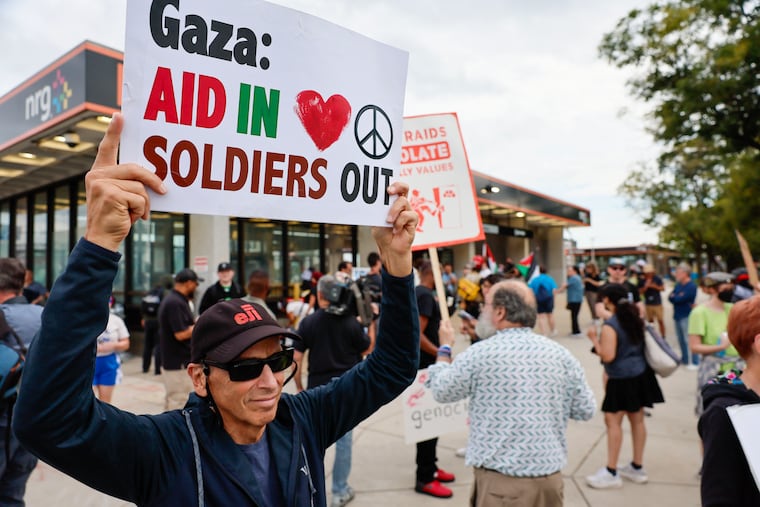
Of course, Kraft’s ham-handed cancelation of Macklemore that infected the Eagles wasn’t just a personal foul against free speech, but wildly counter-productive. It triggered a boisterous pre-concert protest outside the Linc, forced Sheeran to denounce Israel’s actions in Gaza, and prompted an outpouring of support for Palestine from the likes of rocker Dave Matthews, who waved a “STOP GENOCIDE” placard at his concert stops.
If the Streisand Effect means amplifying a rumor by denying it, then spreading a protest by trying to crush it needs to be called the Kraft Effect.
In addition to censorship and secrecy, another hallmark of the 2020s is insanely profitable sports franchises demanding new stadiums when their current home would be barely old enough to drink. The Eagles recently announced they’re exploring the possibility of a new stadium when their lease expires in 2032 — even though the Linc was considered state-of-the-art when it opened just 23 years ago — and politicians like Gov. Josh Shapiro are already working to make sure the team stays in Philadelphia.
Imagine if some of our political leaders got a spine transplant and — instead of throwing incentives at the Eagles like they were Mardi Gras beads — demanded a free-speech policy that would ensure something like the Macklemore debacle never happens again. If the Birds want to build a $2 billion censorship palace, they can spend their own money.
But they shouldn’t do that. Instead, the Eagles need to embrace the idea that you can’t have “One Team. One City. One Dream” without a multitude of voices.
» READ MORE: SIGN UP: The Will Bunch Newsletter