Pa is asking for CDC more emergency aid, but only if measles deaths are reported
Both sides have accused the other of politicizing the measles outbreak.
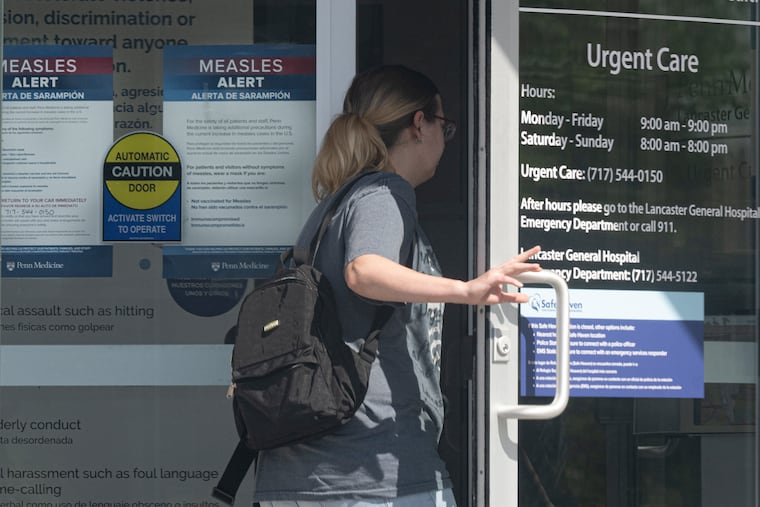
Pennsylvania is seeking more emergency aid from the Centers for Disease Control and Prevention to respond to the state’s largest measles outbreak in more than 30 years, but only if the federal agency acknowledges the four measles-associated deaths Pennsylvania has reported.
The CDC has so far declined to publicly report Pennsylvania’s measles-associated deaths, reportedly at the direction of Health and Human Services Secretary Robert F. Kennedy Jr.
The CDC’s measles dashboard says the agency is still reviewing death data and developing a new standard definition of a measles-associated death.
Public health experts say it is highly unusual for the CDC to challenge routine disease surveillance by states, and delaying death reporting could affect efforts to control Pennsylvania’s outbreak, which has sickened more than 700 people and is now this year’s largest in the country.
“The CDC’s choice not to publicly recognize the deaths undermines our response,” Pennsylvania Health Secretary Debra Bogen wrote in a Wednesday letter to CDC Director Erica Schwartz, a nominee of President Donald Trump who was confirmed to the post last month. The state shared the letter with The Inquirer.
Bogen wrote that the CDC’s Epi-Aid program, which provides short-term technical assistance and subject matter expertise during health crises, will only benefit Pennsylvania’s outbreak response if she can assure her staff that the CDC’s assistance “will not will not undermine their efforts and will partner with them toward a common goal, including publication of timely, accurate information about the outbreak.”
The CDC said it had not received Pennsylvania’s Epi-Aid request “through its normal channels,” and accused state leaders of politicizing outbreak response. Federal outbreak assistance and national mortality reporting are separate issues, the agency said.
“CDC will not submit to political blackmail that conditions critical public health assistance,” the agency said in a statement Thursday. “The people of Pennsylvania should never be used as leverage in a political dispute over how deaths are classified.”
The back-and-forth comes after the CDC has said the state is not cooperating with the agency and, for days, highlighted the fact that health officials here have not requested an “Epi-Aid” team from the agency as other states with measles outbreaks have.
An ongoing political clash
Pennsylvania defines a “measles-associated death” as one that occurs within 30 days of symptom onset in a person with clinical evidence of infection and a positive laboratory test, and who did not die of another unrelated cause, like a car crash.
The state announced its first two measles-associated deaths in late August, but provided no information on them beyond that both were in unvaccinated Lancaster County residents. The county coroner later said he did not believe measles caused one of the deaths, involving an infant with a lacerated spleen who tested positive for measles, though physicians have noted measles can weaken the organ and make it more likely to rupture.
The coroner, an elected Republican, said a second death, in another infant with a fatal genetic condition, was caused by measles.
Two other measles-associated deaths were reported this week in Mifflin and Jefferson Counties. Mifflin County’s coroner confirmed the death of an unvaccinated 18-year-old who died from a serious neurological complication of measles; Jefferson County’s coroner said measles led to the death of an unvaccinated 40-year-old woman with severe respiratory conditions.
Gov. Josh Shapiro, a Democrat, has criticized Kennedy, a longtime anti-vaccine activist, for spreading misinformation and contributing to lower vaccination rates that he says have allowed the virus to spread through 38 counties in Pennsylvania.
Kennedy has accused the state of “fabricating” two deaths, although he later acknowledged one was caused by measles.
Both have said the other is politicizing the deaths, the first reported in Pennsylvania and the highest death toll linked to the virus nationally in more than three decades.
On Wednesday, the state reported that 731 people have been sickened in Pennsylvania so far this year — with 117 cases reported in the last week alone. Just over 140 people had been hospitalized, with 18% of them under 18.
An Epi-Aid team typically works with a state for one to three weeks to provide technical assistance investigating an “urgent public health problem,” according to the CDC’s website.
“The focus of an Epi-Aid investigation is to assist partners in making rapid, practical decisions for actions to control and prevent the public health problem,” the website reads.
In the letter sent to Schwartz on Wednesday, Bogen said that the state is already working closely with the CDC and recently made two requests for “technical assistance” from agency staff.
She said the state appreciated “the CDC professional staff’s timely and thoughtful responses.”
Since the state is still seeing measles cases and deaths, Bogen said, officials are now requesting an Epi-Aid team from the CDC.
But Bogen will rescind the Epi-Aid request “if CDC is unable to transparently and accurately communicate information about those measles-associated deaths,” the letter said.
“While our professional teams have collaborated well on the measles outbreak response, including the identification and reporting of four measles-associated deaths, CDC’s public communication about the deaths has not been reflective of our close collaboration,” she wrote.
Protocol on counting measles deaths
The CDC’s measles webpage, updated weekly with new case information, has featured an asterisk in the column for 2026 deaths.
The CDC initially posted an explanation saying it had omitted Pennsylvania’s deaths because “available information does not establish whether measles caused or contributed to the deaths or whether the individuals died from other causes while infected with measles.”
The agency later updated its asterisk language to note that the National Center for Health Statistics (NCHS) “does not currently have any death records from 2026 that indicate measles is the underlying cause.”
The webpage also says that it is working with the Council of State and Territorial Epidemiologists to develop a standardized case definition for measles deaths, in an effort to promote “consistent classification and reporting of measles deaths across jurisdictions.”
Pennsylvania health officials said their definition of a measles-associated death is modeled after existing CTSE definitions for deaths from other respiratory illnesses like flu.
In the interim, the CDC will wait to report measles-related deaths until the NCHS “identifies measles as the underlying cause based on death record information submitted by the states,” the agency said in a statement to The Inquirer.
Relying on the NCHS for measles deaths is a departure from the CDC’s standard protocol for tracking infectious diseases, said Demetre Daskalakis, a former director of the National Center for Immunization and Respiratory Diseases, which oversees state immunization efforts and disease surveillance within the CDC.
In the past, the CDC has relied on the National Notifiable Diseases Surveillance System, its system for monitoring dozens of diseases, such as meningitis, pertussis, botulism, and measles. States submit new case reports as they obtain them.
States will typically alert the CDC in advance of entering data into the database when it is urgent — for instance, signs of an infectious disease outbreak or a death associated with an outbreak.
This is the approach Pennsylvania’s health department said it took to report its first measles-associated deaths earlier this month.
By contrast, the NCHS database tracks all deaths in the United States, and is the source of the routine Vital Statistics reports. States upload death certificates, and the CDC’s system skims data about primary and secondary cause of death, and any additional details noted. The process can take weeks because states enter each death individually.
With both databases, information entered by states is reviewed for completeness (for instance, to ensure no required fields have been left blank) and then recorded.
“Generally they are cleaning data to make sure it’s coming in as quality data. They’re not litigating the decisions on a death certificate,” Daskalakis said. “This relitigation is highly atypical.”
Deaths in which measles is listed on the death certificate will eventually be logged by the NCHS, but relying on this database will mean a longer delay between when a death occurs and when it is reported nationally.
The CDC did not answer multiple requests for comment explaining its updated protocol.
Slowing down measles death reporting could minimize the outbreak, and give Kennedy time to design new definitions that will manipulate how measles deaths are counted, Daskalakis said.
Daskalakis was among the top CDC officials who resigned last summer after its director at the time, Susan Monarez, clashed with RFK over vaccine recommendations and was fired.
He said he worries that “the goal of the secretary is to say that measles doesn’t kill anyone. And that’s not true, but when you own the keys to the kingdom…”