Is Trump-touted Freedom Fuel from Venezuela? | Will Bunch Newsletter
Plus, Jason Arday becomes a casualty in the “war on woke.”
What a difference three words can make. For weeks, the American body politic has watched the strange relationship between Donald Trump and his ever-present 35-year-old aide Natalie Harp in a state of puzzled silence. Then, Georgia Democratic Sen. Jon Ossoff spoke at a weekend rally and said that Trump “doesn’t want to do the job” and would rather “build his ballroom and travel with Natalie on their apparently defenseless flying palace.” The floodgates opened — on social media and sites like the Drudge Report and in angry retorts from the White House that only threw gasoline on the controversy. It goes to show what Democrats can accomplish when they’re not afraid to speak the truth.
If someone forwarded you this email, sign up for free here.
An expert raises questions about Freedom Fuel and Venezuelan oil
For a government that seems to be in your face 24 hours a day, the Trump regime has managed to produce more mysteries than Sir Arthur Conan Doyle. Where’s Melania? Why was the president’s butt sticking way out at his last event? But here in Philadelphia, one Donald Trump-linked mystery has confounded motorists for weeks.
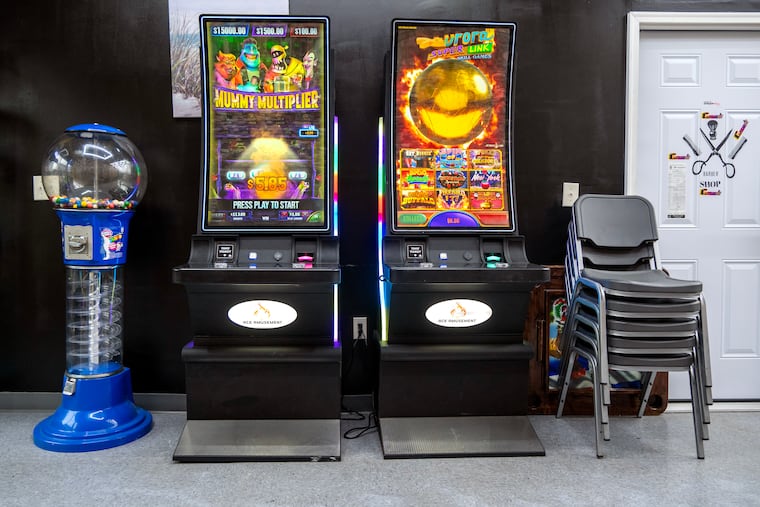
Why is Trump-promoted Freedom Fuel, a web of 29 service stations that popped up out of nowhere this summer, able to continue to sell gas cheaper than its rivals down the street?
The mostly suburban stations in Southeastern Pennsylvania and South Jersey burst onto the scene with prices at $3.47 a gallon — lower than anything since Trump’s disastrous war of choice against Iran launched in late February — and continue to undercut their competitors by about 10-20 cents per gallon. Experts have said that’s not sustainable, unless the stations are somehow getting their gasoline on the cheap.
Now a former high-level State Department official in the Barack Obama administration is trying to connect the dots between the Freedom Fuel conundrum and the ongoing questions about millions of barrels of crude oil Trump has bragged that the United States has taken out of Venezuela.
Jonathan Winer, who recently wrote about Freedom Fuel and Venezuela for the Washington Spectator and discussed his findings on the Court of History podcast, doesn’t connect all the dots, but his research is a reminder of how little the American public knows about the aftermath of the Trump regime’s January assault on Venezuela that captured strongman Nicolás Maduro and installed a friendlier head of state.
The Inquirer and other outlets have reported extensively on Freedom Fuel stations in Greater Philadelphia, including its ties to pro-Trump Republican ex-mayor of Evesham Township, N.J., Randy Brown, who signed Freedom Fuel’s certificate of formation. Former commodities trader Yoni Gontownik — a major donor to GOP causes and a New Jersey-based pro-Israel political action committee — also signed those papers.
Trump promoted the launch of Freedom Fuel on his Truth Social feed, but the White House has denied direct involvement in the flag-themed gas stations, and so has the company itself. “Freedom Fuel Network is a privately owned and proudly patriotic company — along with its convenience store operators, haulers, sign companies, and operational partners — that answered President Trump’s call to action to lower prices at the pump,” it proclaims on its website.
Veterans in tracking the complicated oil market remain baffled. “People can’t mysteriously get fuel at a lower price and continue to offer that,” Winer said on the podcast. “You could, of course, do a very short promotion, but you basically can’t [sustain] it.”
It may be a total coincidence, but the giant enigma that is Freedom Fuel and its cheap gasoline surfaced at exactly the same time the president boasted about the cheap oil the United States is supposedly getting from the resource-rich South American nation his troops invaded.
“We’re taking their oil,” Trump proclaimed about Venezuela while in Las Vegas earlier this month. “To the victor belong the spoils.” He added that what America has taken has paid for the brief January war “many, many, many times.” But analysts know next to nothing about what is actually happening to as much as one million barrels of oil that Venezuela produces every day.
Winer pointed to a couple of common bonds between the efforts to market low-cost gasoline here in Philly and White House efforts to control the flow of Venezuelan oil.
The first is the role of Jarrod Agen, executive director of the National Energy Dominance Council inside the White House, who posted two photos of himself giving a thumbs-up at a new Freedom Fuel station in Philadelphia when it opened on the July 4 weekend. Both Agen and the president himself insisted that the new gas retailer is proof of what the Trump regime is doing to lower prices at the pump.
Winer noted that Agen was also a key member of an American team that traveled to Caracas in April, met with the Trump-backed new president, Delcy Rodríguez, and came home bragging of new commodities deals, including in the oil sector.
The second overlap that Winer points to involves a Texas-based global commodities firm, Mercuria, which announced on May 1 that it had reached a major deal with Venezuela under what it called a “White House-supported initiative.” The announcement featured a photo of a top Mercuria official posing with Agen.
Mercuria told the Washington Post, which has also investigated Freedom Fuel, that it has no involvement with Freedom Fuel. Yet Gontownik, the trader listed as a backer of Freedom Fuel, was also listed as recently as March in campaign finance reports as an executive with Mercuria. But he also insists that he no longer works for the Texas firm — which has been linked to other Trump-regime commodities initiatives. (The ex-Philly journalist Maureen Tkacik, investigations editor at American Prospect, also raises a lot of questions about the role of Mercuria, Gontownik, and the firm Blue Owl Capital, which Trump invested in earlier this year.)
It must be stressed again that all of these connections are circumstantial. At the same time, this much cannot be disputed: The American people have not been given the most basic information about the extent of U.S. involvement in the Venezuelan oil trade, how much money is involved, or where all that money is going at a time when the price of crude oil has skyrocketed.
I could not agree more with Winer’s plea that Congress go after the U.S. Treasury, State, and Energy Departments that are sitting on undisclosed records of U.S.-linked oil transactions — even though realistically that might have to wait until Democrats gain a foothold on Capitol Hill next year. He also called on the media to dig deeper, which is why I wanted to amplify Winer’s early-stage reporting.
Look, we all want to pay less for gas, which is why motorists have been lining up at Freedom Fuel pumps since the stations opened last month. But most of us don’t want to live in a dying empire where a strongman’s tin soldiers steal a sovereign nation’s buried treasure so that favored insiders can profit. We still have no idea what’s been done in Venezuela in our name, and we need to find out.
Yo, do this!
It’s great that people — especially younger people — are returning to brick-and-mortar movie theaters in the long, hot summer of 2026, but the quality of the releases hasn’t really matched the boffo box-office numbers. That may change starting this weekend with the release of Tony, a movie that could have been titled “Becoming Anthony Bourdain.” The film stars Dominic Sessa playing the future chef, author, and beloved TV traveler as a lanky, awkward 19-year-old, spending a summer on Cape Cod and learning to embrace his love for the kitchen — and humanity. I’m really looking forward to this one.
There are two must-read articles out this week from Adam Bonica, a Stanford University professor who specializes in money and politics. The first is his lengthy investigation into dodgy fundraising practices by top Democratic Party committees and leaders, in which endless spam fundraising emails have hit home with susceptible elderly donors, some of whom have drained their life savings. The second is the story behind the story of how both the New York Times and the “Never Trumper” website the Bulwark both chickened out on publishing Bonica’s essential journalism. The cowardice of the elite media in America’s authoritarian moment is beyond disheartening.
Ask me anything
Question: Why aren’t more Democrats supporting and campaigning on the 32 hour work week? It seems like a policy that would appeal to working people across the political spectrum. — brown cloud (@milehighdsa.bsky.social) via Bluesky
Answer: Good question. One political leader, Vermont Sen. Bernie Sanders, has aggressively pushed the 32-hour workweek without a reduction in pay, noting that this would pass the productivity gains of the computer era back to the workers who are being more productive. So, yeah, what’s not to like? It’s certainly true that a lot of Democrats, especially centrists, are heavily dependent on campaign contributions from corporate types who don’t like the idea of a shorter workweek. But I think ultimately, Democratic cowardice on these pro-worker issues goes all the way back to the Ronald Reagan era, and a fear that they’ll be branded by the GOP as the party of “free stuff.” But this isn’t free stuff. We’ve earned it.
What you’re saying about …
Last week’s question about how Democrats should view the primary success of leftists such as Michigan Senate hopeful Abdul El-Sayed drew a response that was both robust (despite the summer doldrums) and fairly unanimous. Proposals from the progressive movement like Medicare-for-All and taxing the wealthy, you agreed, are long overdue. Tom Lees noted that the GOP is trying to find the most extreme democratic socialists, but that “the [Rep. Alexandria Ocasio-Cortez] branch which supports ideas similar to European Social Democrats is the group that is getting people excited.” Craig Strimel added that leftist candidates have failed in the past, but “I also believe that we are so far deep in the current fiasco, and so damned close to total collapse of democracy, that we really are in an all-or-nothing situation right now.”
📮 This week’s question: Georgia Democratic Sen. Jon Ossoff has caused something of a political earthquake with his blunt criticisms of Donald Trump, including a reference to his ever-present young aide Natalie Harp. Has Ossoff crossed a line of incivility that’s a bad look for Dems, or are his criticisms a breath of fresh air? Please email me your answer and put the exact phrase “Ossoff comments” in the subject line.
Backstory on Jason Arday, casualty in the ‘war on woke’
There are two kinds of people in this world. There are normal folks who maybe get a slight whiff of news from the TV or when they boot up their computer, and never heard of a man named Jason Arday. Then there are people who (like me) spend far too much of their day on social media, and now know all about the charismatic Cambridge professor — the youngest Black man to reach those heights in the university’s long history — who came under fire for alleged plagiarism and biographical exaggerations.
The allegations apparently simmered from the day of Arday’s 2023 appointment, but boiled over in recent weeks. He acknowledged some citation errors in his 2015 doctoral thesis — mistakes that Liverpool John Moores University called “honest and reasonable” — but the allegations kept coming. They were fueled by a Cambridge colleague and self-proclaimed “race realist” who went on British national TV to lambaste Arday as “not smart” and label him as merely a diversity hire.
The famously not-laid-back British press went wild on the controversy, with literally hundreds of articles about Arday — not just the Fleet Street tabloids, but even the august Times of London, which ran 60 stories. The media frenzy over the young, dreadlocked sociology of education professor didn’t stop when Arday resigned his Cambridge post, saying that “the relentless accusations, speculation and public commentary have taken a profound toll on me and on those I love.” The media frenzy didn’t even stop when Arday was found dead in his home last Friday. He was 41.
Just one day after Arday’s body was found, Julia Hartley-Brewer, a host on a Rupert Murdoch-owned U.K. TV network, told her audience that Arday “was a liar and a fraud who was rightly exposed for what he really was by academics and journalists who were simply doing their job.”
I’m sorry, but as a lifelong journalist, I never realized that hounding a professor who wasn’t perfect but was loved by his students to his early death is part of the job. To the contrary, I think that good journalism might involve noting that scores of white professors and authors who’ve been caught and admitted to plagiarism or similar issues have been allowed to apologize and go on with their careers. And that bad journalism might be implying that Arday’s middling issues are some kind of commentary on any and every academic with darker skin — as opposed to researching the systemic racism that leaves a supposedly enlightened school like Cambridge with 0.4% Black professors, in an England that’s 4.2% Black.
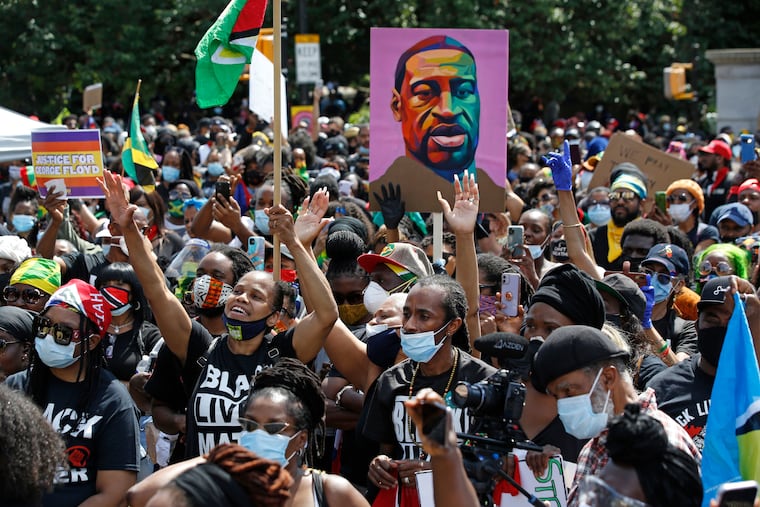
The ghouls who hounded Arday to his death didn’t work in a vacuum. They tapped into a disgusting narrative that way too many journalists and self-appointed public intellectuals are spreading not just in the U.K. and the rest of Europe, but here in the United States. They think the righteous COVID-19-era outcry against police brutality and a grossly unequal society was some kind of mania they’ve branded “Woke 1.0.” Never mind that the police were never defunded in 2020, not even close. The nattering nabobs of anti-wokeness won’t rest until every college classroom or airplane cockpit is made safe for white privilege.
Let me do my job as an opinion writer and tell you what I think about these mostly aging, mostly white, mostly male pundits who have so little to say about right-wing fascism that’s in power in America and on the rise in Britain and instead desperately cling to their status from the perceived threat of a few Black intellectuals. With key elections approaching on both sides of the pond, they opportunistically saw Arday as their latest chance to stir up white voters and preserve the status quo, even if that means tolerating an authoritarian police state. Now, a once-promising Black professor is a casualty in their glorious “war on woke.” Have they no shame?
What I wrote on this date in 2020
As I noted in this space a couple of weeks ago, there’s so much about the peak year of the COVID-19 pandemic that we’ve successfully tried to forget. That includes much about the consequential yet somehow anemic showdown between Donald Trump and Joe Biden, which included their virtual, prepackaged summer conventions. On this date six years ago, I grumpily covered the Democratic National Convention from my couch in Delco and — stop me if this sounds familiar — complained that the party was ducking progressive issues. “If viewers didn’t notice what the Democrats left out in their tightly scripted telethon so focused on Trump’s coronavirus failings and his paranoid style — such as climate change, gun violence, and the other things that young people across America have been marching for — the history books might.”
Please read the rest: “The future is a no-show at telethon-style DNC.”
Recommended Inquirer reading
I’ve cut back on column writing this month, mainly because I’m working on a long-term investigation that I’m really excited about. In my one piece published this weekend, I took a deeper dive into the stunning reports that winter drone attacks on fishing boats off the coast of Ecuador — with eight sailors missing and presumed dead — were a covert operation by Donald Trump’s CIA. This callous disregard for innocent human life is the latest example of a White House death cult that must be held to account by a new Congress, and eventually by prosecutors.
It’s truly remarkable the extent to which public opposition to the data centers that support artificial intelligence, or AI, has gone from near zero to 60 mph (or maybe 80) in a matter of months — especially here in Pennsylvania. With public unrest over these behemoths around their air and noise pollution and impact on electric bills, as well as growing discomfort with AI itself, becoming a key issue in the fall election, The Inquirer has been all over this story. On Tuesday, veteran business columnist Joseph M. DiStefano looked at how major contractors are hoping that demand for new data centers will get them through an otherwise sluggish economy. That might be a pipe dream if municipalities respond to voters by rejecting these proposals, as happened last week with a massive facility planned for suburban King of Prussia. You’re going to want to read The Inquirer’s in-depth coverage of this debate before you vote in November, which means it’s time to finally subscribe. What have you been waiting for?
By submitting your written, visual, and/or audio contributions, you agree to The Inquirer’s Terms of Use, including the grant of rights in Section 10.

Sign up for the Will Bunch Newsletter