We need the truth about Trump’s alleged ‘ballroom’ | Will Bunch Newsletter
Plus, the day Trump left his press corps for dead.
Do rich guys have to ruin everything? Apparently so. There came a time about 15 years ago when my soccer obsession got to the point where I felt I needed to pick an English Premier League team to root for, in addition to the U.S. national teams and the Union. Long story, but I went with Liverpool, in a city many consider the Philadelphia of the U.K., and it’s been a good ride, including a couple of trophies. On Monday, it was reported Amazon gazillionaire Jeff Bezos is buying 30% of the team. I’m officially out. Go, Leeds!
If someone forwarded you this email, sign up for free here.
When did Trump’s ballroom become a national security fortress? We need answers.
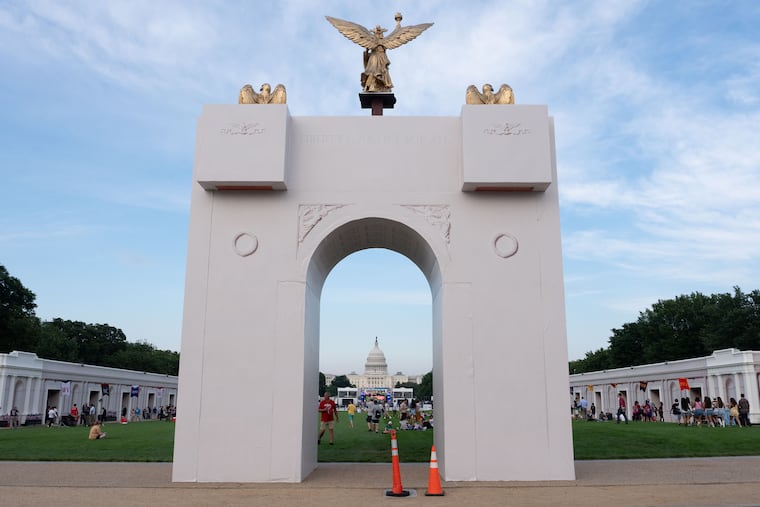
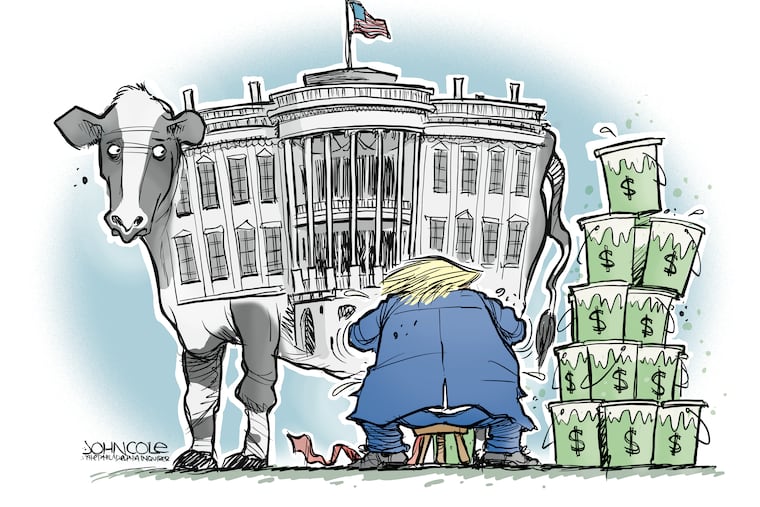
Donald Trump’s originally stated 2025 scheme to demolish the East Wing of the White House to make way for an oversized ballroom to hold state dinners and whatnot was bad enough: an unneeded, unwanted, gilded, and presumably tacky callback to Louis XVI, a massive monument to a modern let-them-eat-cake regime.
A year later, the project is better described as an alleged ballroom — another bait-and-switch scam by America’s first grifter president. The fact that the public really doesn’t know how much this project actually costs — estimates have soared from the initial lowball of $300 million to now at least $600 million, but possibly more — or how much of that will be dumped on U.S. taxpayers is just the beginning of the problem.
Nearly 10 months after the president shocked Washington, D.C., and the rest of America by taking a wrecking ball to the history-packed East Wing, Trump has all but stopped talking about a black-tie party venue and instead rebranded the project as essential to national security.
When the D.C. federal appeals court on Friday ordered the White House, which never got congressional approval for either the demolition or the ballroom addition, to halt aboveground construction, Trump took to Truth Social and described the ruling as akin to treason.
“The Military and Secret Service are viewing this horrendous, politically motivated, and unlawful ruling as a National Security threat to our Nation in that the entire Complex is being built for the protection of our Country and, additionally, all future Presidents,” Trump posted, using language that’s probably never previously in human history been used to describe a “ballroom.”
Trump didn’t say in his post anything about crystal chandeliers, or great acoustics, or things you might expect in a world-class ballroom. Instead, he said the facility will have bomb shelters, a state-of-the-art hospital, top-secret military facilities, protective missile-resistant steel, columns, roofs, and beams, drone-proof ceilings and roofs, military-grade venting, and bullet-, ballistic-, and blast-proof glass.
It sounds like somebody is expecting a last tango in Washington.
Trump’s post was alarming — shocking, really — but in case anyone missed the point, or doesn’t know how to read, he also posted some AI-created renderings, which again did not depict waltzing diplomats, but instead showed a rooftop “DronePort” that was packed to the gills with ominous-looking military drones, manned by troops and also with armored vehicles that somehow drove up there. The vibe was Darth Vader’s Death Star, except with “military-grade venting” this time around.
There are two very different ways to look at all of this, and let’s start with the more benign one. Ever since the beginning of his second crack at the presidency, Trump — when he’s not pursuing his main projects of making billions of dollars, punishing his enemies, and staying out of prison — has been obsessed with placing his personalist stamp on Washington. Maybe that’s for his legacy, or maybe he just wants a Mar-a-Lago-by-the-Potomac to comfort his octogenarian mind.
Trump might not be able to crash weddings as he does at his Palm Beach, Fla., estate, but his ballroom idea would be close enough. Although he’s also sought and received donations for the project from the usual suspects of friendly billionaires and favor-seeking corporations, Trump also wants both additional dollars and — more importantly, in light of the appeals court ruling — a stamp of approval from Congress. That’s been a thwarted agenda item for GOP leaders on Capitol Hill for months.
But if Trump can’t sway Congress, he hopes to win over a U.S. Supreme Court where he has appointed three of the nine members. The White House knows that both Congress and the high court tend to fall in line whenever national security is invoked, while there is no constitutional right to foxtrot. So maybe all the military bluster is just political posturing for Trump’s latest real estate development.
But as the project enters its second year, it seems to have morphed into something a lot more disturbing than that. The pictures, descriptions, and accounts of Trump’s game here are sounding a lot more like the impregnable mountain lair of a Bond villain.
This is a man who fomented an attempted coup the first time he was asked to leave 1600 Pennsylvania Avenue, and who saw how South Korea’s corrupt right-wing president was ousted after a massive throng of protesters overwhelmed key government buildings. Wasn’t it Chekhov who said you don’t put drones up on the roof unless you intend to deploy them by the third act? The two most likely scenarios for actually using Trump’s bunker — Civil War II, or World War III — are less than optimal.
This national security bunker isn’t the only thing that’s worrisome as Trump looks to the second half of what’s supposed to be his final term. As noted in this space recently, Trump has also extended the presence of National Guard troops in Washington through Jan. 20, 2029, which coincidentally is the scheduled last day of his term.
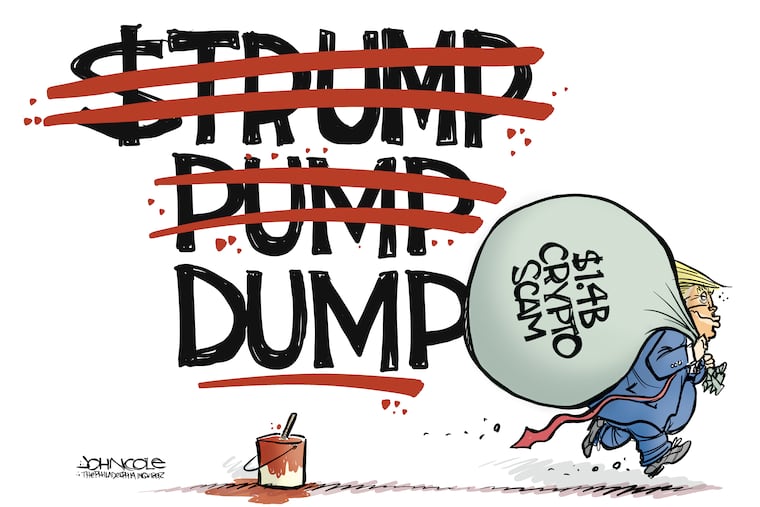
Since their arrival last year, the Guard troops — many from units in pro-Trump red states, and costing U.S. taxpayers at least $1.4 billion and possibly more — have often been spotted hanging around, or picking up trash as a kind of busywork. But residents and some advocates like Scott Michelman, legal director of the American Civil Liberties Union of the District of Columbia, are already complaining Trump is “treating [D.C.] like a police state.”
It raises the same questions as the alleged “ballroom.” The president is entitled to state-of-the-art security, and while the public doesn’t need to know all of the operational details, American taxpayers also can’t be expected to fork over hundreds of millions of dollars for these projects without truly knowing what they are for.
After Jan. 6, 2021, it’s impossible not to think the worst about Trump’s intentions for the White House minifort, or the military occupation of the nation’s capital by a man who expressed open admiration for the bloodshed China’s dictators pulled off in Tiananmen Square.
Democrats on Capitol Hill need to start demanding answers. On Monday, there was an encouraging report by the New Republic’s Greg Sargent that the opposition party is working to demand communications from the Justice and Interior Departments to explain why several people were wrongly criminally charged with vandalism at the Lincoln Memorial Reflecting Pool when the actual damage was a botched repainting contract.
Congress can, and should, also flex its muscles over this ballroom fiasco — first by denying any public money for the project, and then by launching a similar investigation into the hasty demolition, the political fundraising, and the sketchy purposes for the project. Someone owes America the truth, and it’s not going to come from the current regime without a fight.
Whatever happens, the woman or man who hopefully succeeds Trump and sends those guard troops back to their own private Idaho in January 2029 is also going to have a giant mess in their backyard. But it’s better to have the ruins from a botched, halted construction project than from the Battle of Armageddon.
Yo, do this!
The California journalist Gil Durán has been paying attention to the political craziness coming out of Silicon Valley years before anyone else was, and now comes the big payoff in the form of a book that is not only incredibly timely but has the best title of the year: The Nerd Reich: Silicon Valley Fascism and the War on Democracy. Durán explores the strange beliefs of Elon Musk, Peter Thiel, Marc Andreessen, and their friends, their obsession with building their own private “networked cities,” and their unlikely alliance with Donald Trump. I’ve been waiting on this one for a while.
August is always a great month for books. While Durán drills down on the high-tech enemies of liberty, the great writer Dave Zirin has a new tome about one of democracy’s heroes, the late historian Howard Zinn, his former mentor. Public intellectuals are still arguing about the merits of Zinn’s 1980 masterwork, A People’s History of the United States, but nobody disputes his influence on the national conversation. Zinn rejected American exceptionalism, but also spotlighted everyday heroes like labor leaders or civil rights activists who expanded our freedoms over two centuries. I’m looking forward to reading The People’s Historian: The Outsized Life of Howard Zinn.
Ask me anything
Question: Data centers are the flashpoint but the root problem is the unregulated AI that is sweeping up every keystroke and every written document then repackaging it as if original thought. How do we get a federal government mired in 2020 to begin legislating on AI? — Suzi (@wanderponder.bsky.social) via Bluesky
Answer: Great question, Suzi, and I think we all know the main reason why the body politic — and I’m talking about both Democrats and Republicans — have been so painfully slow to respond to voters’ widespread anxiety not only about noisy, polluting, resource-wasting data centers, but also to artificial intelligence itself. The reason is money. Silicon Valley AI developers have raised an unbelievable $220 million to spend on November’s election, and — while there are some disagreements within Big Tech about policy — most of the cash will go to the politicians least likely to regulate an industry badly in need of it. Cognitive computing is not only stealing our intellectual property, as you noted, but also our jobs, as well as our children’s ability to learn. The good news is that public backlash against AI is so strong that even a quarter-billion dollars may not be able to stop the movement. But it’s way past time to get money out of politics.
What you’re saying about …
I should have guessed that newsletter readers don’t have much more of a clue than Donald Trump about what to do about the giant mess in the Persian Gulf. I did get one thoughtful response from an emailer with a “cbluff” handle (Reminder: Please sign your real name to these responses) who said the Trump regime needs to send skilled negotiators — and be realistic. “I believe the U.S. will have to cede the Strait of Hormuz, allow Iran and Oman to collect protection money, remove sanctions and pay them so we can declare victory and leave,” they wrote. It’s hard to disagree. Once again, the United States has lost a war.
📮 This week’s question: Since the Democratic Senate primary win by Michigan’s Abdul El-Sayed last week, the mainstream media has been obsessed with the question of whether this year’s progressive surge, including candidates (although not El-Sayed) tied to the Democratic Socialists of America, is hurting the Democrats. What do you think? Are leftists bringing needed energy to a moribund party, or are they too out there to defeat the GOP in November? Please email me your answer and put the exact phrase “Democrats and the left” in the subject line.
Backstory on the day Trump left his press corps for dead
It was appalling enough back in late July when we watched a room full of some of America’s highest-profile journalists break bread with Donald Trump at the rescheduled White House Correspondents’ Association dinner in Washington, where the president got up and hurled crude insults at several of the media members. Many of us were disgusted that some of the nation’s most respected journalists would platform a man who has repeatedly called a free press “the enemies of the people.” But the White House press corps was in the dark about an even more disturbing plot twist.
Just 16 days earlier, Trump had left some of those journalists for dead — at least potentially — as human decoys who might be blown from the skies in a feared Iranian plot.
The stunning story came out late Monday night as I was writing this newsletter, with a scoop by the Washington Post, matched shortly, with some additional details, by the New York Times. The articles revealed a modern-day Air Force One kind of thriller that essentially involved a shell game with three different aircraft. It was triggered by what officials deemed was a credible Iranian assassination threat against the president when he traveled to a NATO summit in Ankara, Turkey — just over 700 miles from the border with the U.S. enemy.
This launched a series of events, beginning with a plan to abandon Trump’s new, $400 million gift-from-Qatar iteration of Air Force One for an older version that actually has more advanced defensive capacities. Trump was filmed boarding the replacement Air Force One, followed by the White House press corps and some traveling aides for the departure from Ankara to a U.S. air base in Great Britain. What those passengers could not have imagined was that Trump had somehow been spirited out “via a catering container that had been lifted to the opposite side of the plane,” and switched to a C-32A military plane for the flight to the U.K.
Then they kept the unwitting journalists and aides on the ground for a couple of hours before it was revealed POTUS was safely in Britain and the Iranians had been thwarted and … haha, of course that’s not what really happened. No, the press corps took off as human decoys — the latest sitting ducks in an idiotic war that never should have been launched in the first place. Thankfully, no one was hurt … this time. Journalists wondered why they’d been ordered to keep the airplane’s window blinds closed, which inspired this now ironic exchange between Trump and some journalists when they reunited for the flight from Britain back to the U.S.
Trump lied that he didn’t know of any specific plot against Air Force One, and then added: “I’m No. 1 on their list, before you. But if I go, you go. Right?”
Apparently not.
Even as I write this in the middle of the night just hours after the Post and Times scoops, the internet is already flooded with memes depicting Trump crammed into one of those airport serving carts, or pigging out on the adjacent airline food. It’s funny to see that your president isn’t Harrison Ford punching out the terrorists, but, in reality, slinking away in a food truck, leaving other Americans in the line of fire, right?
No, it’s not funny at all. This whole episode is a grand metaphor for a careless president who smashes up things before retreating into his money or whatever keeps him going — not thinking twice about the fate of human beings in a squalid ICE detention camp or an Iranian girls’ school. Or bantering with the gaggle of journalists whom he abandoned after drawing a big target on their backs. The first media question at the next Oval Office event ought to be, “Why did you treat me like cannon fodder?” But I wouldn’t bet on that happening.
What I wrote on this date in 2016
It’s almost funny now, in a dark-comedy kind of way, to look back on the fateful summer of 2016 and remember what it felt like to be stubbornly convinced that something, anything, was bound to happen to stop the obvious insanity of a Donald Trump presidency. It seems so incredibly naive now to read what I believed exactly one decade ago, when I actually thought the success of a diverse and incredibly talented U.S. Olympics team in Brazil would expose the Big Lie of Trump’s racism. I wrote, “The exclamation point is the remarkable women’s gymnastics team led by individual gold medalist Simone Biles — so dominant you will easily forget they also celebrate the kind of diversity that is America’s best feature, not the bug that’s described by the bitter and the disaffected back home.”
Anyway, read it and weep: “Is final nail in Trump’s political coffin made of Olympic gold?”
Recommended Inquirer reading
The fight for America’s future is waged on many fronts, and I’m trying to keep up. Last week, I wrote about a fascinating political development that’s been largely flying under the radar screen: a movement out west to knock off GOP incumbents by creating one-on-one contests with feisty, populist independents. That means long-shot Democrats need to drop out — which has happened in Nebraska, Idaho, and South Dakota, but not in Montana. It’s both a bold plan to end the Republican majority on Capitol Hill and a sad commentary on the failed Democratic Party brand in the American heartland. This weekend, I wrote about the Trump regime’s latest assault on higher education — denying loans for students who major in fields linked to lower-income jobs — and the increasingly bleak future of a liberal arts education. I wondered why Democrats won’t fight harder to end runaway careerism and preserve college campuses as bastions of critical thinking.
This August feels like the calm before the storm in Philadelphia sports. Some of that is the excitement over the Eagles finally being back in training camp and looking to regain that Super Bowl mojo as 76ers fans try to process, if that’s the right term, a once-in-a-lifetime offseason rebuilding project. But much of it is angst over the Phillies, who are clinging by their fingernails to a playoff spot despite adding the National League’s batting champ to a lineup that already includes home run king Kyle Schwarber, future Hall of Famer Bryce Harper, and one of baseball’s best pitching rotations. None of that matters when the Phillies don’t have a relief pitcher who can carry a lead past the 7th or 8th inning. The Inquirer’s ace sports columnists like David Murphy and Marcus Hayes have all asked the same question: Can this team be saved? The answers are just over the paywall, and you can leap over it just like Saquon Barkley at the first-down marker; all you need to do is subscribe to The Inquirer.
By submitting your written, visual, and/or audio contributions, you agree to The Inquirer’s Terms of Use, including the grant of rights in Section 10.

Sign up for the Will Bunch Newsletter